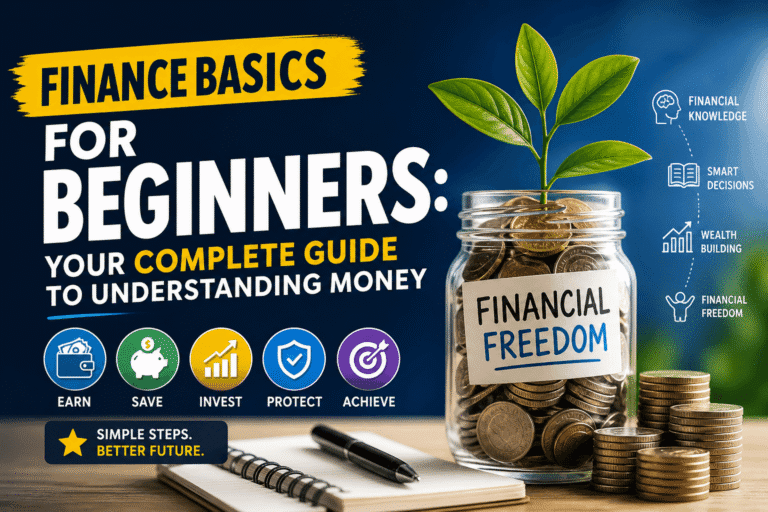
Investing for Beginners: Start with $100 and Grow It into $300,000
Investing for Beginners:
How to Start
Growing Your Money
Investing is not gambling. It is not just for the wealthy. And it is not as complicated as it sounds. This guide explains everything from scratch — with real numbers and zero jargon.
Most people never invest — not because they lack money, but because they think investing is complicated, risky, or only for people who already have wealth. All three beliefs are wrong.
Investing is simply putting your money to work. Instead of sitting in an account earning almost nothing, your money goes into assets that grow over time. The mechanics are straightforward. The results — given enough time — are genuinely life-changing.
This guide starts at the beginning and builds everything you need to make your first investment with confidence.
Section 01
What is Investing? A Plain English Definition
📖 Definition
Investing means putting money into assets with the expectation they will grow in value over time. You accept some degree of risk in exchange for the potential to earn returns that are far greater than a savings account can offer.
Investing vs. saving — what is the difference?
Both involve setting money aside — but the purpose and the outcome are very different:
🏦 Saving
- Money kept in a bank account
- Very low risk — protected by government
- Low returns (1–5% per year)
- Best for: emergency fund, short-term goals
- Fully accessible anytime
📈 Investing
- Money placed in stocks, funds, property
- Carries risk — value can fall short-term
- Higher returns (7–10% average long-term)
- Best for: long-term goals (5+ years)
- Not ideal if you need money soon
The rule of thumb: Save money you will need in the next 3–5 years. Invest money you will not need for 5+ years. Time is what makes investing safe — markets recover from downturns given enough of it.
Section 02
The Power of Compound Interest — With Real Numbers
Compound interest is the single most important concept in all of personal finance. Once you truly understand it, starting early becomes not just sensible but urgent.
📖 What is Compound Interest?
Compound interest means earning returns on both your original money and on the returns you have already earned. Your investment grows — and then that growth itself grows. Over decades, this creates exponential results that feel almost magical.
The starting-age table — the most important numbers in this guide
Let’s look at what happens when three people all invest $100 per month at a 7% average annual return — but start at different ages and retire at 65:
$100/Month Invested at 7% Annual Return
All retire at age 65| Starting Age | Years Investing | Total Contributed | Portfolio Value at 65 | Growth from Compounding |
|---|---|---|---|---|
| Age 22 | 43 years | $51,600 | $329,000 | +$277,400 |
| Age 30 | 35 years | $42,000 | $173,000 | +$131,000 |
| Age 40 | 25 years | $30,000 | $81,000 | +$51,000 |
| Age 50 | 15 years | $18,000 | $32,000 | +$14,000 |
📌 Same $100/month. Same 7% return. Only the starting age is different. Starting at 22 instead of 30 produces $156,000 more — from just 8 extra years. That is the time value of money in action.
💡 The rule of 72 — a mental shortcut
To estimate how long it takes to double your money: divide 72 by your expected annual return rate.
At 7% return: 72 ÷ 7 = ~10 years to double. So $5,000 invested today becomes roughly $10,000 in 10 years, $20,000 in 20 years, $40,000 in 30 years — without adding a single extra penny.
Section 03
Compound Growth Calculator — See Your Future Value
Enter your own numbers to see exactly what consistent monthly investing could be worth over time. Adjust any field and the results update immediately.
Investment Growth Calculator
Based on compound interest with monthly contributions.
Final Value
$0
After 20 years
You Contributed
$0
Your actual money in
Growth Earned
$0
Compound interest at work
Growth Ratio
0×
Return per dollar invested
* Returns are calculated using monthly compound interest at the entered annual rate. Past market performance does not guarantee future results. For illustrative purposes only.
Section 04
The Main Types of Investment — Explained Simply
There are many ways to invest. Here are the four most important ones for beginners, starting with the one most experts recommend as your first step.
Index Funds & ETFs
An index fund automatically tracks a market index — like the S&P 500 — by holding all or most of the stocks in it. One purchase gives you tiny ownership slices of hundreds of companies simultaneously. Low cost, instantly diversified, historically reliable long-term returns.
Warren Buffett has publicly stated that for most people, a low-cost S&P 500 index fund is the single best investment available.
Stocks (Shares)
Buying a stock means buying a small ownership share in a company. If the company grows and performs well, your share value rises and you may receive dividend payments. If the company struggles, your share loses value.
Picking individual stocks requires research and carries higher risk than index funds. Not ideal as a beginner’s first investment.
Bonds
A bond is a loan you make to a government or company. In return, they pay you regular interest over a fixed period, then return your original money at the end. More stable than stocks but lower potential returns.
Bonds are often used to balance a portfolio — adding stability when mixed with stocks. Many index funds include bonds automatically.
Mutual Funds
A mutual fund pools money from many investors and a professional fund manager chooses what to invest in. More actively managed than index funds — which typically means higher fees and, on average, lower long-term returns.
Widely available through banks and pension plans. Check the fees carefully — high management fees significantly erode returns over time.
How do they compare? — Side by side
| Type | Risk Level | Potential Return | Fees | Best For |
|---|---|---|---|---|
| ⭐ Index Fund / ETF | Low–Medium | 7–10% (long-term avg.) | Very low (0.03–0.2%) | All beginners — first investment |
| 📈 Individual Stocks | Medium–High | High potential, high variance | Low (trading fees) | Experienced investors with research time |
| 📄 Bonds | Low–Medium | 2–5% average | Low | Stability; portfolio balance; near retirement |
| 🧺 Mutual Funds | Medium | Variable (often lower than index) | Medium–High (0.5–2%+) | Hands-off investors; check fees carefully |
A fee difference of 1% may sound trivial. Over 30 years on a $50,000 portfolio, a 0.1% fee vs. a 1.5% fee is a difference of roughly $80,000 in final value. Always check the expense ratio before investing in any fund.
Section 05
Risk vs. Reward — What Every Beginner Must Understand
Every investment involves some degree of risk. Understanding risk does not mean avoiding it — it means managing it intelligently. Here are the four most important principles:
The Investment Risk Spectrum
Cash / Savings
Lowest risk
Lowest return
Government Bonds
Very low risk
Low return
Index Funds
Moderate risk
Good return
Individual Stocks
Higher risk
Higher potential
Crypto / Speculation
Highest risk
Unpredictable
For most beginners, the sweet spot is index funds — moderate, diversified risk with historically strong long-term returns.
4 principles for managing investment risk
-
Diversify — don’t put all your eggs in one basket Spreading money across many companies, sectors, and geographies means one failure cannot destroy your portfolio. Index funds do this automatically.
-
Time in the market beats timing the market Markets fluctuate short-term but have historically trended upward over decades. Staying invested through downturns is almost always better than trying to sell at the right moment.
-
Only invest money you will not need for 5+ years If you might need the money soon, keep it in savings. Short investment windows expose you to market downturns you have no time to recover from.
-
Invest consistently — regardless of market conditions Regular monthly investing — “pound-cost averaging” or “dollar-cost averaging” — means you buy more shares when prices are low and fewer when they’re high, smoothing out volatility over time.
Section 06
Before You Invest: The Beginner’s Checklist
Investing is a long-term game — and it works best when the financial foundations beneath it are solid. Before you put money into markets, make sure you can tick each of these:
-
You have a working budget — you know what comes in, what goes out, and you spend less than you earn. Build your budget first →
-
You have an emergency fund — at least 3 months of essential expenses saved and accessible. Without this, one financial shock forces you to sell investments at the wrong time. Build your emergency fund →
-
You have cleared high-interest debt — credit cards and payday loans with 15%+ interest rates. Eliminating this debt guarantees a 15–25% return. No investment reliably beats that. Manage your debt first →
-
You have money you will not need for 5+ years — investing money you need soon is one of the most common beginner mistakes.
-
You understand what you are investing in — never put money into something you cannot explain in one sentence.
📋 Important note on low-interest debt
Low-interest debt (student loans or mortgages under 5–6% interest) can generally coexist with investing — you do not need to clear every debt before starting. The key dividing line is whether the debt interest rate is higher or lower than your expected investment returns.
Section 07
5 Steps to Start Investing as a Beginner
Once your foundations are in place, here is exactly how to start. Take these steps in order.
- 1
Decide on your investment goal and timeframe
Are you investing for retirement in 30 years? A house deposit in 10 years? A general wealth-building fund? Your goal and timeline determines the right level of risk. Longer timelines allow for more exposure to stocks; shorter timelines call for more stability.
- 2
Choose the right account type
In the UK: a Stocks & Shares ISA lets you invest up to £20,000/year with zero tax on gains. In the US: a 401(k) (especially if your employer matches contributions) or Roth IRA are the most tax-efficient starting points. Tax-advantaged accounts are almost always the right place to begin.
- 3
Start with a low-cost index fund
For most beginners, a global index fund or an S&P 500 index fund is the ideal first investment. Look for an expense ratio (annual fee) below 0.2%. Providers like Vanguard, Fidelity, and iShares offer excellent, widely-trusted options. You do not need to research individual companies.
- 4
Set up a regular automatic investment
Decide on a monthly amount — even $25 or $50 is a meaningful start — and set up an automatic investment. This is the investing equivalent of pay-yourself-first. Monthly contributions on a fixed schedule also mean you benefit from pound/dollar-cost averaging automatically.
- 5
Leave it alone — and resist the urge to react
The hardest part of investing is doing nothing. Markets will fall. The news will be alarming. Your portfolio will temporarily go down. The correct response — almost every time — is to stay invested, keep contributing, and let time do the work. Investors who stay the course dramatically outperform those who react to short-term volatility.
A useful perspective: when the market falls and your portfolio dips, your regular monthly contribution now buys more shares for the same money. Market dips are buying opportunities for long-term investors — not emergencies.
Section 08
Common Investing Mistakes Beginners Make
Knowing what to avoid is just as valuable as knowing what to do. These are the most common errors — and how to sidestep each one.
-
Waiting until they have “enough” money to start
People delay investing because they think they need a large lump sum first. As the compound growth table above shows, starting with $50/month at 22 beats starting with $500/month at 40.
✅ Fix: start with whatever you can — even $10/month. Start now. -
Reacting to news and selling during downturns
The market drops, headlines are terrifying, and the instinct is to sell before losing more. In reality, selling locks in a loss that time would have recovered.
✅ Fix: do not check your portfolio daily. Review quarterly at most. Remember: downturns are temporary, the long-term trend is upward. -
Treating investing like gambling — chasing “hot” stocks or trends
Individual stock-picking, cryptocurrency speculation, and chasing last year’s top-performing sector all consistently underperform simple index fund investing over the long term, in study after study.
✅ Fix: boring is effective. A diversified index fund, held for decades, beats almost everything else. -
Ignoring fees
A 1.5% annual management fee vs. a 0.1% fee seems like a small difference. Over 30 years, it can cut your final portfolio value by 30–40%. Fees compound just like returns — in the wrong direction.
✅ Fix: always check the expense ratio. Prioritise low-cost index funds. -
Investing without an emergency fund
Without emergency savings, any unexpected cost forces you to sell investments — possibly at a market low, locking in a loss and paying tax on gains.
✅ Fix: build your 3-month emergency fund first, always. Read: Emergency Fund guide →
⚠️ A note on cryptocurrency and speculative investments
Cryptocurrency, NFTs, and other speculative assets are not covered in this beginner’s guide because they carry extreme volatility, no underlying value guarantee, and are unsuitable as a foundation for beginner investors. If you are curious, only consider them after you have your investment foundations firmly in place — and only with money you could afford to lose entirely.
Continue Your Financial Journey
Investing is most powerful when the foundations beneath it are solid. Here is what to cover next.
Frequently Asked Questions
The most common questions beginners ask about investing.
Investing means putting your money into assets — like stocks, bonds, or funds — with the expectation that they will grow in value over time. Unlike saving, investing carries some risk, but it offers far greater potential returns over the long term. It is the primary way most people build wealth beyond what they earn from work.
You can start with as little as $1 on many modern investment platforms. Most index funds and ETFs allow monthly investments from $10–$50. You do not need a large amount to begin — starting early with a small amount is far more valuable than waiting until you have more money. Time and consistency matter far more than the size of your first investment.
A stock is a small ownership share in a company. Its value rises and falls with the company’s performance and market conditions. A bond is essentially a loan you make to a company or government. They pay you regular interest over a fixed term, then return your money at the end. Stocks offer higher potential returns but more volatility. Bonds offer lower returns but more predictability.
An index fund automatically tracks a market index — like the S&P 500 — by holding all or most of the stocks within it. One purchase instantly diversifies your money across hundreds of companies, sectors, and geographies. Index funds charge very low fees (0.03–0.2% annually), require no stock-picking research, and have historically delivered strong long-term returns. Most financial experts recommend them as the ideal first investment for beginners.
Compound interest means earning returns on both your original investment and on the returns you have already earned. This creates exponential growth over time. For example, $100 invested monthly from age 22 at 7% average annual return grows to approximately $329,000 by age 65 — from just $51,600 contributed. The other $277,400 comes entirely from compounding. Starting early is the single biggest advantage any beginner investor has.
Generally, clear high-interest debt (credit cards, payday loans at 15%+ interest) before investing, because eliminating that debt gives a guaranteed return that typical investments cannot match. However, low-interest debt (student loans or mortgages under 5–6%) can coexist with investing — you do not need to be completely debt-free. Always build an emergency fund before investing, regardless of your debt situation.
Sources & References
7 SourcesThis article draws on research and guidance from authoritative financial regulators, academic institutions, and financial education organisations. All links open in a new tab.
- 1
Introduction to Investing — Basics for Investors
U.S. Securities and Exchange Commission (SEC) · Investor.gov
Regulator ↗ - 2
Investing — Definition, Types, and How It Works
Investopedia — Financial Education & Reference
Reference ↗ - 3
Smart Investing Basics — FINRA Investor Education
FINRA (Financial Industry Regulatory Authority)
Regulator ↗ - 4
Save and Invest — Financial Planning Guidance
MyMoney.gov · U.S. Financial Literacy and Education Commission
Government ↗ - 5
Financial Literacy and Investment Behaviour Research
Global Financial Literacy Excellence Center (GFLEC) · George Washington University
Academic ↗ - 6
Investments and Pensions — Guidance for Beginners
MoneyHelper · Money and Pensions Service · UK Government
Government ↗ - 7
⚠️ Important disclaimer
This article is written for general educational purposes only and does not constitute financial, investment, tax, or legal advice. All investment figures are illustrative estimates based on historical averages and are not a guarantee of future performance. Investment values can go down as well as up. Always consult a qualified, regulated financial adviser before making investment decisions. Past performance is not a reliable indicator of future results.