Build Wealth from Scratch: Finance Basics for Beginners
Finance Basics for Beginners: Your Complete Guide to Understanding Money
Never learned about money in school? You’re not alone. This guide explains finance from scratch — in plain English, with real examples and zero jargon.
Section 01
What is Finance?
Definition
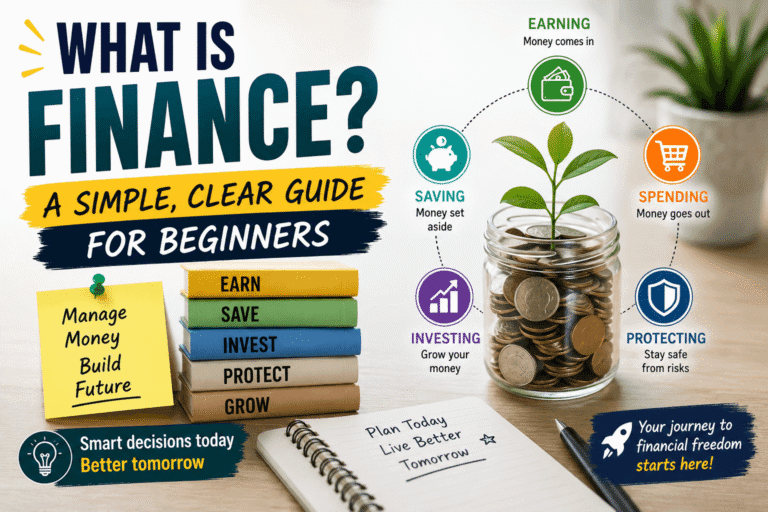
Finance is the management of money. It is about how money is earned, spent, saved, invested, and protected — both today and in the future.
Think of it this way: every time you receive your salary, pay a bill, put money into a savings account, or even decide to buy a coffee instead of making one at home — that is finance. You are already doing it. The goal of learning finance is to do it better.
Many people believe finance is only for accountants, bankers, or the wealthy. That is a myth. Finance is for everyone. Whether you are a student, a first-time employee, a parent, or a small business owner, understanding how money works will always work in your favour.
💡 Simple Example
Imagine you earn $500 per month. Finance is the thinking behind what you do with that $500 — how much you spend, how much you save, whether you invest some of it, and how you make sure you’re not left with nothing at the end of the month.
Without any financial thinking: you might spend all $500 and have nothing left by day 20. With basic financial thinking: you spend wisely, save a little, and slowly build a cushion for the future.
That difference — spending everything versus managing intentionally — is what finance is all about.
Section 02
What Does Finance Cover?
Finance is not just one thing. It covers five core activities that affect every person’s financial life:
Earning Money
Your salary, business income, freelance work, side hustles — any money that comes in.
Spending Money
Rent, food, transport, entertainment — the day-to-day costs of living your life.
Saving Money
Setting money aside for future goals — an emergency fund, a holiday, a house deposit.
Investing Money
Putting money to work in assets — stocks, bonds, or funds — so it can grow over time.
Protecting Money
Insurance and risk management — making sure one bad event doesn’t destroy your finances.
A healthy financial life means you are actively thinking about all five of these areas — not just one or two. Most beginners focus only on earning and spending, and wonder why they never seem to get ahead. The magic happens when you also save, invest, and protect.
Section 03
Why Does Finance Matter in Real Life?
You might be thinking: “I’m getting by fine. Why do I need to learn about finance?” Here’s the honest answer — the people who understand finance, even at a basic level, live very differently from those who don’t.
Here is what a lack of financial knowledge looks like in practice:
- You earn a good salary but always feel broke by the end of the month.
- You rely on credit cards for emergencies because you have no savings cushion.
- You pay minimum payments on debt — and watch the balance barely move.
- You delay retirement planning because it “feels too early” — and then regret it later.
- You have no idea how much money is coming in or going out each month.
And here is what basic financial knowledge looks like:
- You know exactly where your money goes — and you are in control of it.
- You have an emergency fund that protects you when life gets unpredictable.
- You are slowly building wealth, even on a modest income.
- You make informed decisions about big purchases, loans, and investments.
- You feel less stressed about money — because you have a plan.
The truth: Financial literacy is not about being rich. It is about making smart decisions with whatever money you have — whether that’s $300 or $3,000 a month.
Section 04
The Three Types of Finance
Finance does not only apply to individuals. It operates at three different levels — personal, business, and government. Here is a quick comparison of all three:
Managing your own money
- Creating a budget
- Building an emergency fund
- Saving for goals
- Investing in stocks or funds
- Paying off debt
- Planning for retirement
Managing a company’s money
- Raising capital from investors
- Deciding which projects to fund
- Managing business cash flow
- Budgeting for operations
- Handling business loans
- Planning for expansion
Managing a government’s money
- Collecting taxes
- Funding education and healthcare
- Building infrastructure
- Managing national debt
- Creating economic policies
- Setting national budgets
As a beginner, your most important focus is personal finance. That is where the biggest impact on your daily life comes from. We will go deeper on that in the next section.
Section 05
Personal Finance: A Deep Dive for Beginners
Personal finance is the practice of managing your own money across six key areas. You do not need to master all six at once. Start with the basics and build from there.
1. Budgeting — Know Where Your Money Goes
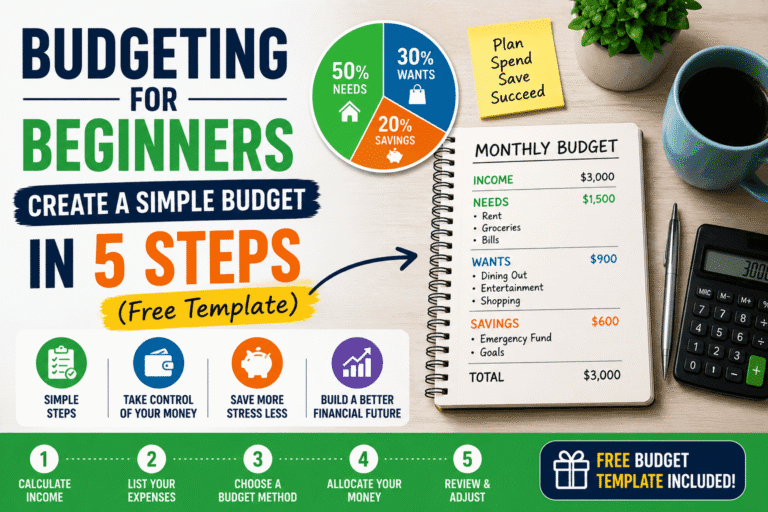
A budget is simply a plan for your money. You write down how much money you earn each month, then decide in advance how much you will spend, save, and invest.
📝 Simple Budgeting Rule: The 50/30/20 Method
50% of your income goes to needs (rent, food, transport, bills).
30% goes to wants (dining out, entertainment, hobbies).
20% goes to savings and debt repayment.
Budgeting is the foundation of everything else. Without it, you cannot know if you are spending too much, saving enough, or heading towards financial trouble.
2. Saving — Building Your Financial Safety Net
Saving means setting aside a portion of your income regularly — before you spend. The most important thing to save for first is an emergency fund: three to six months of living expenses, kept in a separate bank account.
Why? Because life is unpredictable. Your car breaks down. You lose your job. You have a medical bill. An emergency fund means these events are an inconvenience, not a crisis.
3. Investing — Making Your Money Grow
Investing means putting your money into something — a stock, a bond, a property — with the expectation that it will grow over time. Unlike saving, investing carries risk. Your money can go up or down. But over the long term, investing is the primary way most people build real wealth.
The best time to start investing is early — not when you feel rich. Even small amounts, invested regularly, compound into significant wealth over decades. This is the power of compound interest (more on that below).
4. Managing Debt — Staying in Control
Debt is borrowed money — a loan, a credit card, a mortgage. Some debt is useful (a student loan, a business loan). Some debt is harmful (high-interest credit card debt). The key is to understand your debt, pay more than the minimum whenever possible, and avoid accumulating debt faster than you can pay it off.
5. Insurance — Protecting What You Have
Insurance is your financial shield. It protects you from large, unexpected costs. Health insurance covers medical bills. Life insurance protects your family if you pass away. Property insurance covers your home or car. Paying for insurance feels like wasted money — until the moment you actually need it.
6. Retirement Planning — Thinking About Future You
Retirement planning means saving and investing today so that you can stop working one day without running out of money. The earlier you start, the easier it becomes — because your money has more time to grow. Starting at 25 instead of 35 can double your retirement wealth, even with the same monthly contributions.
Section 06
Basic Principles of Finance Every Beginner Should Know
These are the foundational ideas that underpin all of finance. Once you understand them, a lot of financial advice will start to make intuitive sense.
-
1
Money has a time value
A dollar today is worth more than a dollar in the future. Why? Because money available now can be invested, saved, or used — and therefore grows. This is why saving early beats saving late, and why paying off debt quickly saves you money.
-
2
Higher reward always comes with higher risk
A savings account gives low interest but is very safe. Stocks can earn much more — but their value can also drop. Understanding this trade-off helps you make better investment decisions based on your goals and comfort level.
-
3
Compound interest is the most powerful force in personal finance
When you earn interest on your savings, and then earn interest on that interest, your money grows exponentially over time. Albert Einstein reportedly called it “the eighth wonder of the world.” Whether it works for you (savings, investments) or against you (debt), you need to understand it.
-
4
Diversification reduces risk
Do not put all your eggs in one basket. If you invest everything in one company and it fails, you lose everything. Spreading your money across different investments — different sectors, countries, and asset types — means one failure won’t ruin you.
-
5
Spend less than you earn
This sounds obvious, but it is violated constantly. The difference between what you earn and what you spend is your financial oxygen. The bigger that gap, the more you can save and invest — and the faster you build financial security.
Section 07
Finance in Action: A Real-Life Example
Let us bring everything together with a practical example. Meet Sarah. She earns $500 per month from her part-time job. Here is what her finances look like with and without a plan.
Sarah’s plan — with basic financial thinking:
Sarah’s Monthly Budget · $500 Income
Sarah is not earning a lot — but she is building good habits. In 12 months, she will have saved $1,200 in her emergency fund and invested $1,200. That invested $1,200, left untouched for 30 years at a 7% average annual return, grows to approximately $9,100. Not because she earned more — but because she started early and stayed consistent.
🔁 The Compound Interest Effect
$100 invested per month from age 22, growing at 7% per year, becomes roughly $262,000 by age 62.
The same $100/month starting at age 32 (just 10 years later) becomes roughly $122,000.
Same effort. Same amount. A decade’s difference = $140,000 less. That is the time value of money in action.
Section 08
How to Start Managing Your Finances: 5 Simple Steps
You do not need to change everything at once. Follow these five steps, in order, and you will be in a stronger financial position than most people around you.
-
1
Track what you earn and spend for one month
Do not change anything yet. Just observe. Write down every amount that comes in and goes out. Use a notebook, a spreadsheet, or a free budgeting app. Awareness is the first step. You cannot fix what you cannot see.
-
2
Create a simple monthly budget
Once you know your numbers, create a plan. Use the 50/30/20 rule as a starting point. Assign every dollar a purpose before the month begins. A budget is not a restriction — it is a permission slip to spend on what matters, guilt-free.
-
3
Open a separate savings account and build your emergency fund
Open a savings account that is separate from your main account. Set up a small automatic transfer on payday. Aim for $500 first, then $1,000, then three months of expenses. Keep this money untouched — it is your financial safety net.
-
4
Tackle any high-interest debt
If you have credit card debt or other high-interest loans, focus on paying these off as quickly as possible. High interest debt can easily cancel out all your savings and investments. Becoming debt-free is a powerful financial achievement.
-
5
Start investing — even a small amount
Once you have a budget, savings, and manageable debt, begin investing. Start small. Many investment platforms allow you to invest from as little as $10 per month. A simple index fund is a great starting point for beginners — low cost, broadly diversified, and proven over time.
Do not try to do everything at once. Start with Step 1. Just tracking your money for 30 days will give you more financial clarity than most people have. Progress, not perfection, is the goal.
Go Deeper: Explore All Finance Topics
This guide is your starting point. Click any topic below to read the full in-depth guide for each area of personal finance.
Frequently Asked Questions
These are the questions most beginners ask when they first start learning about finance.
Finance is the management of money. In simple terms, it covers how money is earned, spent, saved, invested, and protected over time. Whether you are planning your personal budget or a company is deciding how to fund a new project, that is finance in action.
The three main types are personal finance (managing your own money — budgeting, saving, investing), corporate finance (how businesses raise and manage money), and public finance (how governments collect taxes and fund public services). For beginners, personal finance is the most relevant starting point.
Understanding basic finance helps you avoid unnecessary debt, build savings, make smarter spending decisions, and plan for the future. You do not need a large income to benefit from financial knowledge. Even small, consistent changes in how you manage money can significantly improve your financial wellbeing over time.
Saving means keeping money in a safe place — like a bank savings account — for short-term needs and emergencies. It is low risk and easy to access. Investing means putting money into assets like stocks or funds with the goal of growing it over the long term. Investing carries more risk but offers much higher potential returns. Both are important: you save first, then invest.
Start by tracking all your income and expenses for one month. Then create a simple budget using the 50/30/20 rule. Once you know your numbers, open a savings account and start building an emergency fund. After that, focus on clearing high-interest debt, and then begin investing — even a small amount each month makes a long-term difference.
Compound interest is when you earn interest on both your original money and on the interest you have already earned. Over time, this creates exponential growth. For example, $100 invested monthly at 7% annual return from age 22 becomes roughly $262,000 by age 62. Starting just 10 years later yields around $122,000. That is the power of compound interest — and why starting early matters so much.
Sources & References
12 SourcesThis guide was written using information from authoritative, independent sources including government financial bodies, nonprofit financial education organisations, and peer-reviewed research. All external links open in a new tab. Our editorial team reviews sources at least once per year to ensure accuracy and relevance.
🏛️ Government & Regulatory Sources
Money as You Grow — Financial Literacy Resources
Consumer Financial Protection Bureau (CFPB) · U.S. Government
GovernmentIntroduction to Investing — Investing Basics
U.S. Securities and Exchange Commission (SEC) · Investor.gov
GovernmentSave and Invest — Personal Finance Guidance
MyMoney.gov · Financial Literacy and Education Commission (U.S.)
GovernmentMoneyHelper — Free & Impartial Money Guidance
Money and Pensions Service · UK Government
Government🏦 Nonprofit Financial Education Organisations
Personal Finance Resources — Financial Education
National Financial Educators Council (NFEC)
NonprofitFinancial Education Standards & Guidelines
Jump$tart Coalition for Personal Financial Literacy
NonprofitInvestor Education & Financial Fundamentals
FINRA (Financial Industry Regulatory Authority)
NonprofitNext Gen Personal Finance — Free Curriculum Resources
Next Gen Personal Finance (NGPF)
Nonprofit Edu🔬 Academic & Research Sources
Financial Literacy Research & Global Reports
Global Financial Literacy Excellence Center (GFLEC) · George Washington University
ResearchFinancial Literacy and Financial Well-Being
Federal Reserve — FEDS Notes · Federal Reserve Board
Research📖 Trusted Finance Reference & Education Sites
Finance — Definition, Types, and Overview
Investopedia — Financial Education & Reference
ReferencePersonal Finance — Free Video Lessons
Khan Academy — Free World-Class Education
Free Education⚠️ Editorial Disclaimer
This article is written for general educational purposes only and does not constitute financial, investment, tax, or legal advice. The information provided reflects general principles of personal finance and is not tailored to any individual’s specific financial circumstances. Always consult with a qualified, licensed financial professional before making financial decisions. External links are provided for reference only — we are not responsible for the content or accuracy of third-party websites. All figures and calculations are illustrative estimates and may not reflect actual investment outcomes.