How to Save Money Fast: 10 Effective Techniques That Actually Work
How to Save Money:
A Simple Guide
for Absolute Beginners
Saving is not about willpower. It is about systems. Build the right habits once — and your money starts growing automatically, even when life gets busy.
Here is something nobody tells beginners about saving money: it is not a discipline problem. Most people who struggle to save are not lazy or careless. They simply have not built the right systems yet. Once the systems are in place, saving becomes almost automatic — and the results compound in ways that feel genuinely remarkable.
This guide builds those systems for you, step by step.
Section 01
Why Saving Feels So Hard — And Why That Is Completely Normal
Before we talk about how to save, it is worth understanding why most people find it difficult. Because if you have struggled to save in the past, there is a very good reason for it — and it is not a character flaw.
Our brains are wired to favour immediate rewards over future ones. A coffee today feels real. Having $2,000 saved in a year feels abstract. This is called present bias, and it affects almost everyone. It is not weakness — it is psychology. Which is exactly why willpower-based approaches to saving almost always fail.
The solution is not to try harder. The solution is to remove the decision entirely — to automate saving so the choice is made once and then never has to be made again. That is the foundation of everything in this guide.
📊 The real cost of not saving
Imagine two people, both earning $1,500/month. Person A saves nothing and spends everything. Person B saves $150/month (10%) automatically. After 5 years, Person A has $0 in savings. Person B has $9,000 — plus any interest earned. Same income. Different system. Completely different financial reality.
Section 02
The #1 Rule of Saving: Pay Yourself First
📖 The Golden Rule
Pay yourself first means transferring a set amount to savings the moment your income arrives — before bills, before groceries, before anything else. Savings become your first expense, not an afterthought.
Most people save whatever is left at the end of the month. The problem: there is almost never anything left. Life — groceries, a night out, an unexpected bill — always finds a way to fill available money. Pay-yourself-first flips the order entirely.
The Pay-Yourself-First Flow
Payday arrives
Your salary lands in your current account
Savings transfer — automatic
A pre-set amount moves to your savings account immediately. You never see it.
Bills and spending
You live on what remains — and it feels completely normal within 2–3 months.
Savings grow
Month after month, automatically, without willpower.
✅ How to set it up: Log into your bank app, find the “standing order” or “recurring transfer” feature, and set an automatic transfer from your current account to your savings account for the day after payday. Most banks allow this in under 5 minutes.
Research published by the CFPB and echoed by behavioural economists consistently shows that people who automate savings save significantly more than those who rely on manual transfers — even when their income is identical. Automation removes the decision; removing the decision removes the failure point.
Section 03
How to Set Savings Goals That Actually Work
Saving without a goal is like driving without a destination. You will stop and start, lose motivation, and dip into the fund when tempted. A clear goal — with a specific number and deadline — changes everything. It makes saving feel purposeful rather than punishing.
Savings goals fall into three time horizons. Every beginner should aim to have at least one goal from each category:
0–12 months
Build your foundation
- Starter emergency fund ($500–$1,000)
- Clear a small debt
- Save for a specific purchase
- Build a “no-stress” buffer
- One month of expenses saved
1–5 years
Build momentum
- Full emergency fund (3–6 months)
- House deposit / down payment
- Pay off all high-interest debt
- New car (without a loan)
- Career development fund
5+ years
Build wealth
- Retirement savings
- Investment portfolio
- Children’s education fund
- Financial independence
- Major life milestone fund
📝 How to write a SMART savings goal
Vague goal: “I want to save more money.” → No deadline, no amount, easily ignored.
SMART goal: “I will save $1,000 in my emergency fund by December 31st by transferring $84 automatically every month.” → Specific, measurable, achievable, relevant, time-bound. Far harder to abandon.
Section 04
Savings Calculator — See Exactly When You Will Reach Your Goal
Enter your monthly saving amount and your savings goal. The calculator will show you exactly how long it will take — and how much interest you could earn along the way.
Your Savings Calculator
Adjust the values to match your situation. Results update instantly.
Time to Goal
7 months
By Dec 2025
Total Saved
$1,050
Your contributions
Interest Earned
$18
Money working for you
* Interest is calculated as simple monthly compounding at the rate entered. Actual returns will vary by account and provider. For educational purposes only.
Section 05
How Much Should You Save Each Month?
There is a standard guideline — save 20% of your take-home income — but that number can feel unreachable when you are just starting out. Here is the honest truth about saving percentages:
📝 What does this look like at different income levels?
$800/month income → 10% = $80/month saved. In 12 months: $960 saved. A meaningful emergency fund.
$1,500/month income → 15% = $225/month saved. In 12 months: $2,700 saved. Full starter emergency fund plus beginnings of an investment fund.
$2,500/month income → 20% = $500/month saved. In 12 months: $6,000 saved. Solid emergency fund and meaningful investment contributions.
The 1% trick: Increase your savings rate by just 1% every time you get a pay rise or reduce an expense. You will never feel the difference month to month — but over years, it compounds dramatically. Going from 5% to 15% is just ten 1% increases.
Section 06
10 Practical Money-Saving Tips for Beginners
These are not generic tips. Each one is specific, actionable, and actually makes a measurable difference. Work through the list and pick the ones that apply to your situation.
-
1
Audit your subscriptions — today
Open your bank statement and highlight every recurring charge. The average person has 3–5 subscriptions they have forgotten about. Cancel anything you haven’t used in the past 30 days. This takes 20 minutes and often saves $30–$80/month immediately.
💰 Typical saving: $30–$80/month -
2
Switch to cooking at home 4 extra days per week
The average home-cooked meal costs about $3–$5 per person. The average restaurant meal or takeaway costs $15–$25. Four fewer meals out per week = $48–$80 saved per week, or $200–$320 per month. Cooking more is the single highest-impact saving habit for most beginners.
💰 Typical saving: $150–$320/month -
3
Use the 24-hour rule for non-essential purchases
Before buying anything over $30 that was not planned, wait 24 hours. If you still want it the next day, buy it guilt-free. Most impulse purchases evaporate overnight. This single rule eliminates a surprising amount of spending without feeling restrictive.
💰 Typical saving: $50–$150/month -
4
Switch your savings to a high-yield account
Standard savings accounts often pay 0.1–0.5% interest. High-yield savings accounts (HYSAs) frequently offer 4–5%+ APY. On $2,000 saved, that is the difference between earning $2 per year and earning $90 per year — for doing absolutely nothing different. Switch once, earn more forever.
💰 Earn more on what you already save -
5
Meal plan one week ahead
People who shop without a list spend an average of 20–30% more on groceries due to impulse buys. Spend 15 minutes on Sunday planning the week’s meals, write a specific shopping list, and stick to it. Also: never shop hungry.
💰 Typical saving: $40–$100/month on groceries -
6
Negotiate your regular bills
Many service providers — internet, phone, insurance — will offer a better rate if you simply call and ask. Say: “I’ve seen better deals elsewhere — is there anything you can do to keep me as a customer?” This works more often than most people expect. One phone call can save $15–$40/month per provider.
💰 Typical saving: $20–$60/month -
7
Implement a “no-spend” weekend once a month
Choose one weekend per month where you spend nothing on wants — no eating out, no online shopping, no entertainment purchases. Instead: cook, walk, use what you already have. Most people find these weekends surprisingly enjoyable, and save $60–$150 effortlessly.
💰 Typical saving: $60–$150/month -
8
Save every windfall — 50% rule
When unexpected money arrives — a bonus, a tax refund, birthday money — immediately save 50% before spending any of it. The other 50% is yours to enjoy guilt-free. This builds savings at a pace that feels invisible, because windfall money was never in your budget to begin with.
💰 Impact: accelerates savings without sacrifice -
9
Use cashback apps and cards strategically
For purchases you are already making (groceries, fuel, utilities), use a cashback credit card — paid off in full every month — or a cashback app. This is not an excuse to spend more. It is a way to recoup 1–5% on spending you were going to do anyway. Over a year, this quietly adds up to $100–$400 for many households.
💰 Typical saving: $100–$400/year -
10
Track your net worth monthly — even roughly
Add up everything you own (savings, investments, anything of value) and subtract everything you owe (debts, loans). Write this number down each month. Watching this number grow — even slowly — is one of the most powerful motivators for continuing to save. What gets measured gets improved.
💡 Motivational impact: very high
Section 07
Where to Keep Your Savings
The account you save in matters. The wrong account earns almost nothing. The right account earns meaningfully more — on exactly the same money, with exactly the same effort.
High-Yield Savings Account (HYSA)
Offers 4–5%+ APY vs. the 0.1% of standard accounts. Fully accessible. FDIC/FSCS insured. Usually offered by online banks.
Best for: emergency fund + short-term goalsStandard Savings Account
Offered by your main bank. Low interest (0.1–0.5%), but convenient. Good as a temporary holding place while you set up a HYSA.
Good for: getting started quicklyFixed-Term / CD Account
Higher interest rate in exchange for locking money away for a fixed period (3, 6, 12 months). Good for money you will not need immediately.
Good for: medium-term goals you won’t touchYour Current / Checking Account
Earns virtually no interest. Keeping savings here means the money blends with spending money and tends to disappear.
Avoid: for any savings purposeThe golden rule for your emergency fund: Keep it in a separate account from your everyday spending — ideally at a different bank. Separation creates a psychological barrier that prevents casual dipping. It should be accessible within 1–2 business days, but not instant like a debit card. Read our full Emergency Fund guide →
Section 08
Saving Habits: What Actually Works vs. What Doesn’t
Most saving advice focuses on what to do. This section is equally about what not to do — the common patterns that feel like saving but quietly undermine it.
| ❌ What doesn’t work | ✅ What actually works |
|---|---|
| Saving whatever is left at month-end | Automating savings the moment income arrives — pay yourself first |
| Keeping savings in the same account as spending | A separate savings account (ideally at a different bank) |
| Vague goal: “I want to save more” | Specific goal: “$1,000 emergency fund by December — $84/month” |
| Stopping savings when an unexpected cost appears | Reducing the amount temporarily, but keeping the habit alive |
| Waiting until you earn more to start | Starting with whatever you can — even $20/month — right now |
| Tracking savings once a month (or never) | A 5-minute weekly check-in to see progress and maintain motivation |
| Cutting everything enjoyable to save faster | A balanced approach that includes a planned “wants” budget |
⚠️ The most common beginner mistake
Stopping all saving when life gets difficult, and planning to “restart properly” later. This is the single most damaging habit. Reduce the amount if you must — but never stop entirely. Even $5 transferred automatically keeps the habit, the account, and the momentum alive.
Your Next Steps in the Series
Saving money is Step 2 of your financial journey. Here’s what builds on it.
Frequently Asked Questions
The most common questions beginners ask about saving money.
Start small and automate it. Even $20 or $30 per month matters more than saving nothing. Set up an automatic transfer to a separate savings account on payday — before you have a chance to spend it. The habit of saving something consistently, regardless of the amount, is the foundation that everything else builds on.
Pay-yourself-first means transferring a set amount to savings the moment your income arrives — before paying bills or spending on anything. Savings become your first financial obligation, not your last. It is the most effective saving strategy because it removes the decision entirely. You set it up once; it runs automatically from then on.
The standard guideline is 20% of take-home income. But starting with 5–10% is absolutely fine — what matters is making it automatic and non-negotiable. Increase your saving rate by 1% every time your income rises or you cut an expense. Ten 1% increases gets you from 5% to 15% without ever feeling a significant reduction in lifestyle.
For your emergency fund and short-term goals: a high-yield savings account (HYSA) at a separate bank from your everyday account. HYSAs typically offer 4–5%+ interest vs. 0.1% on a standard account. The separate account prevents you from casually spending savings, and the higher rate means your money grows faster without any extra effort.
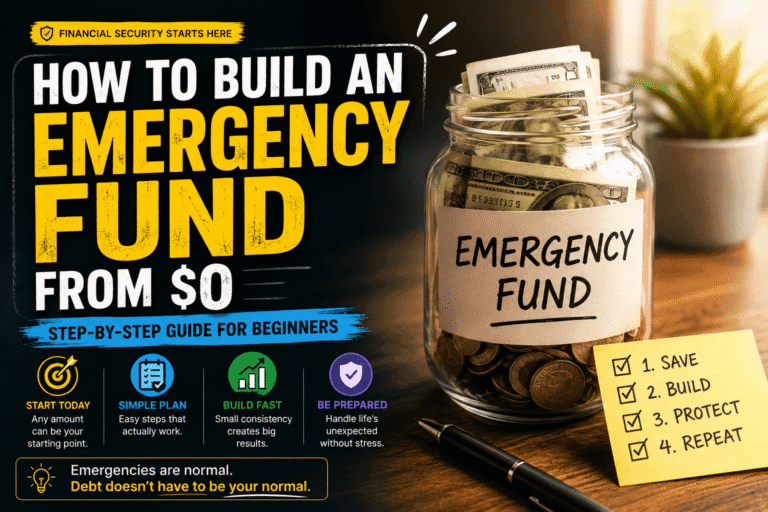
An emergency fund is money set aside exclusively for genuine unexpected costs — job loss, a medical bill, urgent car or home repair. Every beginner should build one before investing. Start with a $500–$1,000 target, then grow it to 3–6 months of essential living expenses. It turns financial emergencies into manageable inconveniences.
It depends on your monthly saving amount and your goal. For example: saving $100/month reaches $1,000 in 10 months. Saving $200/month reaches $1,000 in 5 months. Use the interactive savings calculator in Section 4 of this guide to calculate your exact timeline based on your own figures. The answer is almost always more achievable than people expect.
Sources & References
6 SourcesThis article draws on research and guidance from authoritative financial education organisations and government bodies.
- 1
Consumer Financial Protection Bureau — Saving and Budgeting Guidance
Consumer Financial Protection Bureau (CFPB) · U.S. Government
Government ↗ - 2
- 3
- 4
Financial Literacy and Savings Behaviour Research
Global Financial Literacy Excellence Center (GFLEC) · George Washington University
Academic Research ↗ - 5
- 6
Financial Literacy and Financial Well-Being
Federal Reserve Board · U.S. Government
Government Research ↗
⚠️ Disclaimer
This article is written for general educational purposes only and does not constitute financial, investment, or legal advice. Savings rates, interest rates, and account features change frequently — always verify current rates with your bank or financial provider. All figures are illustrative examples only.