what is finance in simple words? The Easiest Explanation You’ll Read Online
What is Finance?
A Simple, Clear Guide
for Beginners
You’ve heard the word a thousand times. Now let’s actually explain it — in plain English, with everyday examples, zero jargon, and zero assumption that you already know anything.
You have probably heard the word “finance” hundreds of times. At school. On the news. Maybe from a parent who was stressed about money. But nobody ever stopped to clearly explain what it actually means — or why it matters to you, right now, wherever you are in life.
So let’s fix that. This guide explains finance from the very beginning — no background knowledge needed. By the end, you will know exactly what finance is, what it covers, and the first practical steps you can take to start managing your money better.
Section 01
What is Finance? The Simple Definition
Finance in one sentence
📖 Definition
Finance is the management of money. It covers how money is earned, spent, saved, invested, and protected — for individuals, businesses, and governments — over time.
That’s it. No complicated formula. No economics degree required. Everything in finance comes back to that one idea: how money is managed.
Breaking the definition down
Let’s take the word “management” seriously for a moment. Managing money doesn’t just mean having it. It means making intentional decisions about what to do with it. Do you spend it now or save it for later? Do you keep it in a bank account or invest it so it can grow? Do you borrow money for a big purchase, or wait until you have saved enough?
Every one of those choices is a financial decision. Finance is the system of thinking that helps you make those choices — wisely.
What finance is NOT — busting 4 common myths
“Finance is only for rich people.”
Finance applies to every income level. In fact, basic financial knowledge matters most when money is tight.
“You need a finance degree to understand it.”
Personal finance is a practical skill. The core concepts are straightforward and learnable by anyone.
“Finance is just about investing in stocks.”
Investing is just one part. Finance also covers budgeting, saving, debt, insurance, and planning.
“I’m too young / my income is too small to worry about finance.”
Starting young — even with a small income — is one of the most powerful financial advantages you can have.
The word origin: “Finance” comes from the Old French word finer, meaning to settle a debt or make a payment. Even centuries ago, it was simply about dealing with money — nothing more mysterious than that.
Section 02
What Does Finance Actually Cover?
Finance is not a single thing — it is a set of five interconnected activities. Every financial decision you make falls into at least one of these categories:
Earning Money
Your salary, freelance work, business income, or side hustle. Any money that flows into your life.
Spending Money
Rent, food, transport, entertainment. Any money that flows out. The goal is to spend intentionally, not mindlessly.
Saving Money
Setting money aside for future needs — an emergency fund, a deposit, a goal. Safety first.
Investing Money
Putting money into assets — stocks, funds, property — with the expectation it will grow. Higher potential, higher risk.
Protecting Money
Insurance, risk management, and smart planning — so one unexpected event doesn’t undo everything you’ve built.
📝 Putting it together
Most people focus only on earning and spending — and wonder why they never seem to get ahead. The real shift happens when you actively manage all five areas. Even small improvements in saving, investing, and protecting create compounding results over time.
Section 03
Finance in Your Everyday Life
Here’s something most people don’t realise: you are already doing finance every single day. You just might not be thinking of it that way.
Meet Jamie. Jamie is 24, works a part-time job, lives in a shared flat, and has never taken a finance course. Let’s follow Jamie through an ordinary Tuesday and see how many financial decisions appear.
-
7:30 AM
Makes coffee at home instead of buying one Spending
A small spending decision. Making coffee at home costs roughly £0.20 vs. £3.50 at a café. Over a working year, that’s a potential saving of £800+. Finance shows up even here.
-
9:00 AM
Payslip arrives — direct debit auto-saves 10% Saving
Jamie set up an automatic transfer to a savings account on payday. The money moves before it can be spent. This is the “pay yourself first” principle — one of the most powerful habits in personal finance.
-
12:30 PM
Pays rent by bank transfer Spending
Rent is a fixed, non-negotiable expense — a “need” in budgeting terms. Jamie already knows this figure and has planned for it. No stress, no scramble. That’s the result of having a budget.
-
6:00 PM
Renewed renter’s insurance for the year Protecting
A £12/month policy that covers Jamie’s belongings in case of theft, fire, or flood. Jamie hasn’t needed it yet — and hopes never to. But when something does go wrong, that £144/year will feel like the best decision ever made.
-
8:30 PM
Transferred £50 to an index fund Investing
Jamie has been doing this every month for 18 months. It doesn’t feel like much. But £50/month invested at a 7% average annual return grows to roughly £36,000 over 20 years. Finance is not about big decisions — it’s about consistent small ones.
The key insight: Finance was not happening to Jamie — Jamie was doing finance all day. The difference between people who build financial security and those who don’t is usually not income — it is awareness and intention.
Section 04
What is Finance and Why is it Important?
You might still be thinking: “I’m getting by fine — why do I actually need to understand finance?” Here is the clearest answer: the people who understand finance, even at a basic level, live materially different lives from those who don’t.
This is not about income. It is about decisions. Here is what that looks like in practice:
| ❌ Without financial knowledge | ✅ With basic financial knowledge |
|---|---|
| You earn a decent salary but feel broke by the 20th of the month | You know exactly where your money goes — and you are in control of it |
| You rely on credit cards for unexpected expenses because there is no savings buffer | Your emergency fund handles surprises without adding debt |
| You pay minimum payments on debt, watching the balance barely move | You have a payoff plan and can see real progress each month |
| You delay thinking about retirement because it feels too far away | You are investing small amounts early, letting compound growth do the heavy lifting |
| Big purchases (car, holiday, new device) cause financial anxiety for weeks | You save purposefully for goals — and enjoy them guilt-free when you reach them |
| Money is a constant source of stress and conflict | You have a plan — and even if things get tight, you have options |
The cost of financial ignorance — some real numbers
According to research from the Global Financial Literacy Excellence Center, people with low financial literacy are significantly more likely to carry high-interest debt, have no retirement savings, and experience financial fragility. A 2022 Federal Reserve study found a direct correlation between financial literacy and overall financial wellbeing — across all income levels.
The good news: you don’t need a finance course or a degree. You just need the basics — which is exactly what this guide and its companion articles cover.
Section 05
The Three Main Types of Finance
Finance doesn’t only apply to individuals. It operates at three levels — personal, business, and government. Here’s a quick overview of each:
Managing your own money
The most relevant type for beginners. Covers the financial decisions you make in your own life.
- Creating a monthly budget
- Building an emergency fund
- Saving toward goals
- Investing for the future
- Managing and clearing debt
- Planning for retirement
Managing a business’s money
How companies raise capital, manage cash flow, and make investment decisions.
- Raising funds from investors
- Deciding which projects to fund
- Managing business cash flow
- Planning for business growth
- Setting operating budgets
- Handling business loans
Managing a government’s money
How governments collect revenue and allocate spending for public services.
- Collecting taxes from citizens
- Funding schools and hospitals
- Building infrastructure
- Managing national debt
- Setting economic policy
- Creating national budgets
As a beginner, your focus should be almost entirely on personal finance. That is where the most immediate, practical impact on your daily life comes from. For a deeper dive into all three types, read our full guide: Types of Finance — Personal, Corporate and Public Explained →
Section 06
How is Finance Different from Accounting and Economics?
These three words are often used interchangeably — but they mean different things. Here is a simple breakdown:
| Field | Focus | Key question it answers | Real-life example |
|---|---|---|---|
| Finance | Planning and managing money for the future — decisions about how to grow, invest, and allocate funds | “What should I do with my money going forward?” | Deciding whether to invest £200/month in an index fund or pay off your credit card first |
| Accounting | Recording and reporting what has already happened financially — tracking past income, expenses, and transactions | “What has happened with money in the past?” | Filling in a tax return, or reviewing last month’s bank statement to see where you spent |
| Economics | Studying how economies, markets, and societies produce, distribute, and consume goods and services at scale | “How does money flow across societies and markets?” | Understanding why inflation is rising or why interest rates affect mortgage costs |
💡 Simple analogy
Finance is the pilot deciding where to fly the plane. Accounting is the flight log recording where the plane has already been. Economics is the study of how the whole air traffic system works.
You need a little awareness of all three — but for managing your own money, finance is the one that matters most.
Section 07
What Should a Beginner Learn First?
Now you know what finance is. Here are the five things to learn and apply — in order. Take them one at a time. Each builds on the one before it.
-
1
Learn how to create a budget
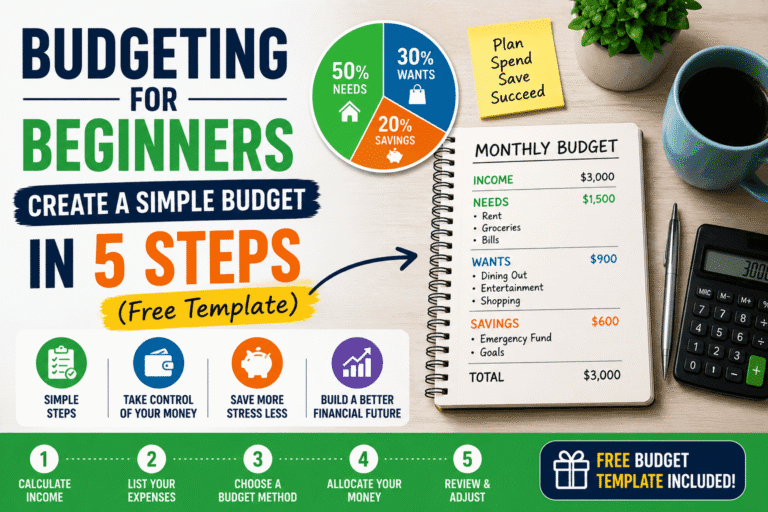
A budget is your financial foundation. Without knowing where your money goes, you cannot improve anything else. Start with the 50/30/20 rule — 50% needs, 30% wants, 20% savings and debt. Read: Budgeting Basics for Beginners →
-
2
Start saving money — even a small amount
Before you do anything else, build a safety net. Your first goal: save £500 to £1,000 as a starter emergency fund. This one step changes how you relate to money entirely. Read: How to Save Money →
-
3
Build a proper emergency fund
Once you have a starter fund, grow it to 3–6 months of living expenses. Keep it in a separate savings account that you do not touch except for genuine emergencies. Read: Emergency Fund — What It Is and How to Build One →
-
4
Understand and manage any debt
If you have high-interest debt — credit cards, payday loans — address it urgently. High interest quietly destroys wealth faster than almost anything else. Know what you owe, the interest rate on each debt, and have a payoff plan. Read: Debt Management for Beginners →
-
5
Begin investing — even a small amount
Once you have a budget, savings, and manageable debt, start investing. Even £20–£50 per month in a simple index fund is a meaningful start. Time in the market matters far more than the amount. Read: Investing for Beginners →
Not sure where to start? The full Finance Basics for Beginners guide walks through all of these steps with detailed examples and real numbers. It is your complete roadmap from zero to financially confident.
Explore Every Finance Topic
This article is Cluster 01. The full series covers 12 topics — click any to go deeper.
Frequently Asked Questions
The questions beginners ask most when they first start learning about finance.
Finance is the management of money. In the simplest terms, it is about how money is earned, spent, saved, invested, and protected over time. It applies to everyone — not just accountants or bankers — because every person, business, and government makes decisions with money every single day.
The word “finance” comes from Old French and Latin roots meaning to settle or pay a debt. Today, it refers to the broad field of managing money — covering five core activities: earning, spending, saving, investing, and protecting money. It applies to individuals, businesses, and governments equally.
The three main types are personal finance (managing your own money — budgeting, saving, investing), corporate finance (how businesses raise and manage money), and public finance (how governments collect taxes and fund public services). For most beginners, personal finance is the most important and relevant place to start.
Finance shapes virtually every major life decision — from paying rent and buying food, to taking out a loan, planning for retirement, and building long-term security. Without basic financial knowledge, it is very easy to overspend, accumulate high-interest debt, and struggle to reach important life goals.
Finance focuses on planning and managing money for the future — decisions about how to grow, invest, and allocate money going forward. Accounting focuses on recording and reporting what has already happened with money — tracking past income, expenses, and transactions. Think of finance as planning the journey, and accounting as the record of where you’ve already been.
Absolutely — and confidently. Personal finance is a practical life skill, not an academic subject. The concepts most beginners need — how to budget, save consistently, avoid high-interest debt, and start investing — are genuinely straightforward and learnable by anyone willing to spend a few hours reading.
Sources & References
7 SourcesThis article was written using information from authoritative, independent sources. All external links open in a new tab. Sources are reviewed at least annually.
-
1
Finance — Definition, Types, and Overview
Investopedia — Financial Education & Reference
Reference Site ↗ -
2
Financial Literacy and Education Resources for Consumers
Consumer Financial Protection Bureau (CFPB) — U.S. Government
Government ↗ -
3
Introduction to Investing and Finance Basics
Khan Academy — Free World-Class Education
Free Education ↗ -
4
Financial Literacy Research and Global Reports
Global Financial Literacy Excellence Center (GFLEC) · George Washington University
Academic Research ↗ -
5
Financial Literacy and Financial Well-Being — FEDS Notes
Federal Reserve Board — U.S. Government
Government Research ↗ -
6
Personal Finance — Free Video Curriculum
Next Gen Personal Finance (NGPF) — Nonprofit Financial Education
Nonprofit Edu ↗ -
7
MoneyHelper — Free and Impartial Money Guidance
Money and Pensions Service · UK Government
Government ↗
⚠️ Disclaimer
This article is written for general educational purposes only and does not constitute financial, investment, tax, or legal advice. Always consult a qualified, licensed financial professional before making financial decisions. All calculations are illustrative estimates.