What Does Scaling Mean in Business? Simple Explanation (With Real Examples)
What Does Scaling Mean in Business?
You hear the word everywhere — investors use it, coaches repeat it, companies celebrate it. But what does “scaling” actually mean? Once you understand it clearly, you’ll start seeing it everywhere — and know exactly how it applies to your business.
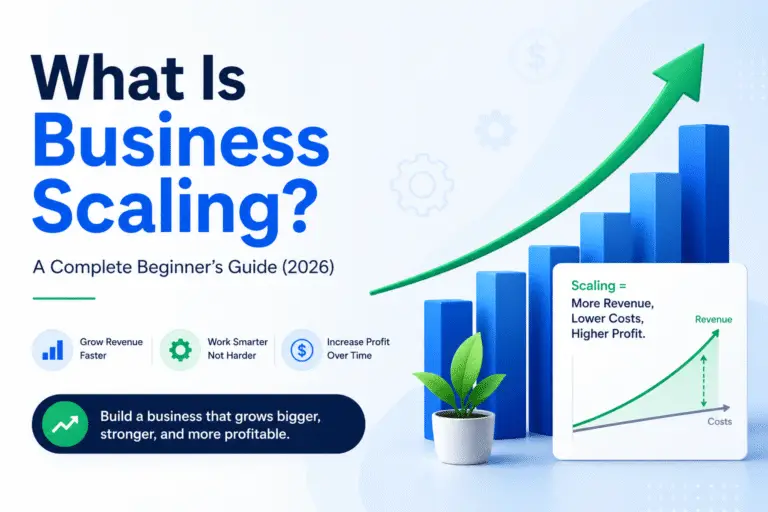
Scaling in business means increasing your revenue significantly without increasing your costs at the same rate. When a business scales, it serves more customers, generates more revenue, and becomes more profitable — without needing proportionally more time, people, or money to do so.
Where the Word “Scaling” Comes From
The word scaling comes from the Latin scalae, meaning stairs or a ladder. In business, it describes a company’s ability to climb higher — generate more revenue — without each step up requiring the same effort or cost as the last.
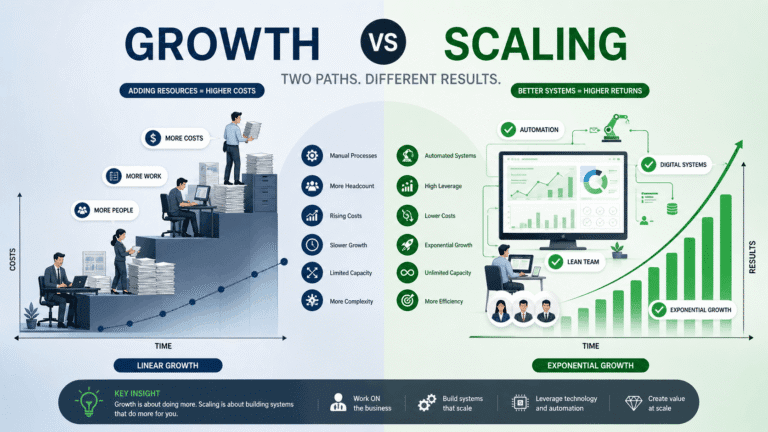
That is the key insight. When you grow a business in the traditional sense, every step up the ladder costs roughly the same. Hire a new person, serve one more client. Open a new location, add more overhead. The ladder goes up, but it takes the same energy to climb each rung.
Scaling redesigns the ladder itself. When you scale, you build a structure where each step up becomes easier, more efficient, and less expensive than the one before. More customers, better margin. More revenue, same team.
The OECD formally defines a scale-up as a business that achieves 20% or more annual growth for at least three consecutive years, starting from a baseline of 10 or more employees. This definition is used by economists, investors, and governments worldwide to distinguish true scale-ups from businesses that simply expand in size.
Important: You do not need to hit this threshold to be scaling. The principle — revenue growing faster than costs — applies at any size. The OECD definition is a benchmark for formal classification, not a requirement for your strategy.
The Four Dimensions of Scaling
Scaling is not a single action. It has four distinct dimensions, each of which can be pursued independently or together. Understanding all four helps you see the full picture of what scaling means in your specific context.
Operational Scaling
Building systems, SOPs, and processes so your business can deliver more without the founder or team working more hours proportionally.
Revenue Scaling
Increasing revenue from existing customers or channels without proportional new investment. Upselling, cross-selling, improving conversion rates.
Geographic Scaling
Expanding a proven model into new markets, cities, or countries using the same playbook that worked in the original market.
Technology Scaling
Using automation, AI, and software to handle tasks that previously required human time. Each tool multiplies what your team can accomplish.
Most businesses do not need to pursue all four dimensions at once. In fact, trying to scale in every direction simultaneously is a common mistake that leads to diluted focus and poor execution. The smarter approach: pick the one dimension most aligned with your current model and resources — and scale that one thing deeply before adding another.
What Does Scaling Mean Across Different Business Types?
Scaling looks different depending on your business model. Here is what it means in the five most common contexts:
| Business Type | What Scaling Looks Like | Why It Works |
|---|---|---|
| SaaS / Software | Adding users to an existing platform. Each new customer costs almost nothing to serve once the software is built. | Marginal cost per user approaches zero. Gross margins often exceed 70%. |
| E-Commerce | Using automated fulfilment, AI product recommendations, and email sequences to serve 10× more customers without 10× more staff. | Revenue per employee rises. Logistics and ad automation are the main levers. |
| Service Business | Productising a bespoke service into a fixed-scope package that a trained team — not the founder — delivers. | The founder steps back. Delivery becomes consistent, predictable, and delegatable. |
| Digital Products | Creating a course, template, or tool once and selling it to thousands. Zero incremental production cost. | The purest form of scaling — one unit of effort, unlimited units of revenue. |
| Local Business | Building a repeatable franchise or licensing model so others can operate your brand with their own capital. | Revenue multiplies without proportional capital investment from the founder. |
Across all five business types, the universal truth is the same: the business finds a way to earn more without spending proportionally more. That is the universal meaning of scaling, regardless of industry.
What Scaling Does NOT Mean
Just as important as understanding what scaling means is knowing what it does not mean. These misconceptions are widespread and expensive:
- Scaling does not mean growing fast. Speed is not the defining feature. A business can grow very quickly while still spending proportionally more on every new dollar of revenue. Fast growth without improving efficiency is not scaling.
- Scaling does not mean raising money. Capital can accelerate scaling, but it does not create it. Many businesses scale profitably using only operational cash flow. Many others raise millions and never achieve true scale because the underlying model is not efficient.
- Scaling does not mean hiring aggressively. If your headcount grows in step with your revenue, you are growing — not scaling. True scaling means hiring more slowly than revenue grows, because your systems and technology are carrying the load.
- Scaling does not only apply to tech companies. Any business — service, retail, professional firm, or local shop — can move toward scaling by building better systems and leveraging technology. The ceiling varies, but the principle is universal.
- Scaling is not something you do once. It is an ongoing capability you build into the architecture of your business. The most scalable businesses are constantly asking: how can we serve more people with less friction?
How to Tell If Your Business Is Scaling or Just Growing
Here is the practical test. Look at your last 6 months of financials and operations:
Signs You Are Scaling
- ✦ Profit margin improves as revenue grows
- ✦ Revenue grows faster than headcount
- ✦ Systems handle work — not just people
- ✦ New customers cost progressively less to acquire
- ✦ Founder works fewer hours as revenue increases
Signs You Are Just Growing
- ✦ Costs rise in line with every revenue increase
- ✦ Every new client needs a new hire
- ✦ Founder is still the main bottleneck
- ✦ Profit margin stays flat or shrinks
- ✦ Business depends entirely on key individuals
The margin test is the clearest single signal. If your gross margin is improving as revenue grows, you are scaling. If it is staying flat or shrinking, you are growing — not scaling. Track this number every month without exception.
The Scaling Equation: How to Think About It Mathematically
You do not need to be a mathematician to understand this. But framing scaling numerically makes the concept concrete.
According to industry research cited by McKinsey, businesses that focus on scaling efficiency rather than raw growth achieve disproportionately higher returns and are significantly more resilient to market downturns. The businesses that build the widest gap between revenue and cost growth are the ones that compound value fastest.
Why Scaling Matters More Than Ever in 2026
Understanding what scaling means is more practically important in 2026 than at any previous point — for three concrete reasons:
AI and Automation Have Removed Most Barriers
The tools that enable scaling — automation, CRM, AI-powered customer service, digital distribution — are now available to any business at low cost. As McKinsey’s AI research highlights, integrating AI is no longer optional for businesses that want to scale in 2026. It is the new baseline.
The Data Gap Is Widening
The SBA Office of Advocacy reports that a business with 10–19 employees now generates an average of $2.16 million in annual revenue — compared to $387,000 for a business with 1–4 employees. That 5× difference reflects the compounding advantage of systems, automation, and leverage that scaling businesses build over time.
Global Competition Makes Efficiency Non-Optional
Staying local and manual in a global digital economy is an increasingly vulnerable position. Businesses that understand and apply scaling principles — serving more people with less friction — have a structural advantage over those that simply add resources proportionally every time they grow.
Key Takeaways
- ✦ Pillar Page: The Complete Guide to Business Scaling (2026)
- ✦ Article 1: What Is Business Scaling? A Complete Beginner’s Guide
- ✦ Article 2: Business Scaling vs Business Growth: The Critical Difference
- ✦ Article 4: Signs Your Business Is Ready to Scale (Coming next →)
Frequently Asked Questions
What does it mean when someone says a business is scaling?
Does scaling always mean getting bigger?
Can a service business scale?
What is the difference between scalable and sustainable?
What does scaling mean for a startup specifically?
- OECD (2025) — Unleashing SME Potential to Scale Up — Primary global research defining scale-up benchmarks and SME scaling patterns.
- Monkhouse & Company — What Does Scaling Up Mean? The Definitive Guide (2026) — Practitioner guide by a founder who scaled two UK tech companies to £30M ARR.
- Upwork — How to Scale a Business in 2026: 9 Strategies for Success — Practical nine-strategy framework for scaling across business types.
- Strategy Ladders — How to Scale a Business: Step-by-Step Blueprint — SaaS and e-commerce-focused scaling guide with actionable steps.
- McKinsey & Company — The Multiplier Effect of Scaling — Research on what separates businesses that scale from those that stagnate.
- SBA Office of Advocacy — Small Business Facts & Statistics — U.S. government source for all small business revenue and headcount data.