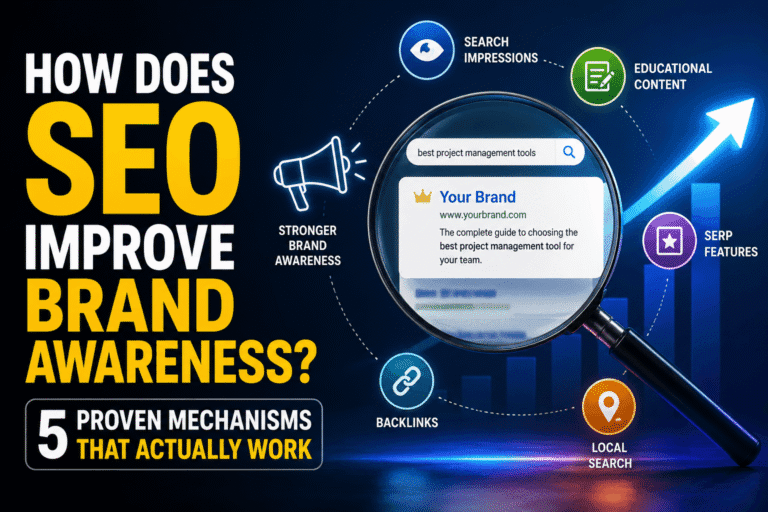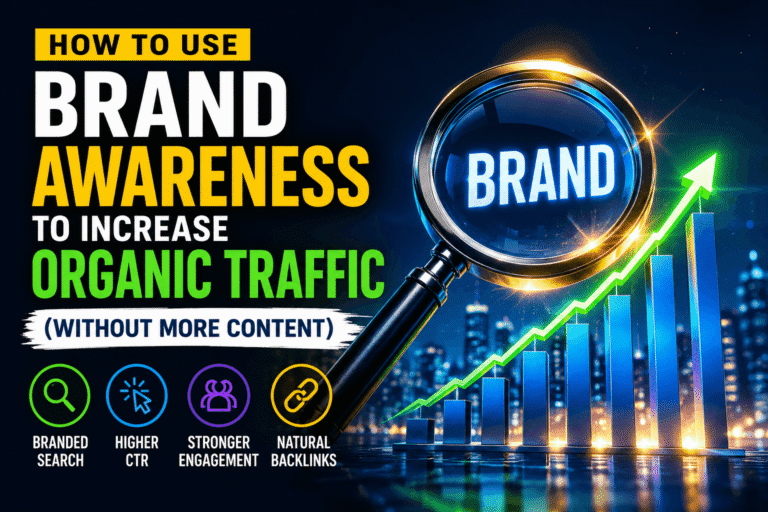
How to Increase Brand Awareness with SEO: 7 Proven Strategies
You publish great content. You optimize your pages. But still, nobody seems to know your brand exists.
Sound familiar?
Here’s the hard truth: most businesses treat SEO and brand awareness as separate goals. One is for traffic. The other is for marketing. But in 2026, the brands winning in search aren’t just ranking; they are recognized. And that recognition is what turns visitors into loyal customers.
In this guide, you’ll learn exactly how to improve brand awareness with SEO using seven field-tested strategies that work even if your site is new, your budget is small, and the competition feels overwhelming.
What Is Brand Awareness in SEO (And Why It Matters More Than Ever)
Brand awareness in SEO refers to how often, how widely, and how consistently your brand appears across search results, AI-generated answers, and digital conversations, even when people aren’t searching for you by name.
Think of it this way: if someone searches “best email marketing tools” and your brand shows up three times in the results, that’s brand awareness at work. They may not click every time. But they remember you.
Why does this matter in 2026? Because search has changed dramatically. Google’s AI Overviews, ChatGPT, and Perplexity now pull brand recommendations from trusted editorial content, not just ad spend. According to BrightEdge, over 68% of online experiences still begin with a search engine, and brands with consistent visibility in those results earn 3x more trust than those relying solely on paid ads.
The bottom line: if you’re not building brand awareness through SEO, you’re handing visibility to your competitors on a silver platter.
Strategy 1: Build Topical Authority Through Content Clusters
The single most powerful thing you can do to improve brand awareness with SEO is to become the go-to source on your topic, not just rank for one keyword.
This is called topical authority, and it works like this:
- Choose one core topic (your “pillar”)
- Create a comprehensive pillar page (e.g., “The Ultimate Guide to Email Marketing”)
- Build 8–15 supporting articles around subtopics (e.g., “email segmentation,” “email automation,” “email deliverability”)
- Interlink them all together.
When someone searching any part of your topic keeps seeing your brand answering their questions, something powerful happens: they start searching for you by name. That branded search volume growth is a direct signal to Google that your brand matters.
Real-world example: A SaaS startup in the HR space published a pillar guide on employee onboarding, supported by 12 cluster articles. Within six months, their branded search volume increased by 41% and organic traffic doubled, all without spending a dollar on ads.
Action step: Use Google’s “People Also Ask” and “Related Searches” to map your content cluster before you write a single word.
Strategy 2: On-Page SEO That Reinforces Your Brand Identity
On-page SEO isn’t just about cramming keywords into headings. Done right, it’s a brand-building tool.
Here’s how to use on-page SEO for brand visibility:
- Consistent brand voice in title tags and meta descriptions. Your meta description is a 155-character ad. Write it to sound like you, not a robot.
- Schema markup for brand entities. Use the Organization and Website schema to help Google understand who you are as a brand, your name, logo, social profiles, and contact details.
- Branded anchor text in internal links. When you link internally, occasionally use your brand name as the anchor to reinforce your brand identity in Google’s entity graph.
- Author bios on every article. Link to a real person’s profile. Google’s E-E-A-T guidelines reward content with demonstrable human expertise.
Expert Insight (what most blogs miss): Most on-page SEO guides tell you to add keywords to your H1 and first paragraph. They skip the most powerful on-page brand signal: your URL structure. A clean, branded domain with consistent URL slugs (e.g., yourbrand.com/seo-brand-awareness) reinforces brand recognition every time someone shares or bookmarks your link.
If you’re new to implementation, this step-by-step guide on integrating SEO into your content breaks down the exact process from keyword research to optimization.
Strategy 3: Content Marketing That People Actually Share
Search rankings drive initial visibility. But shareability is what turns SEO into brand awareness at scale.
The content types that consistently generate organic brand mentions and backlinks in 2026:
- Original data studies (e.g., “We analyzed 500 landing pages, here’s what worked”)
- Comprehensive how-to guides (like this one)
- Tools and templates (calculators, swipe files, checklists)
- Contrarian takes (“Why Most SEO Advice Is Wrong About Brand Awareness”)
Each time someone links to your content, references it in a forum, or shares it on social media, they’re creating what SEO professionals call a brand mention, a powerful unlinked citation that search engines and AI platforms use to validate your brand’s authority.
According to SparkToro’s 2025 web engagement analysis, brands with consistent editorial mentions across 20+ publications saw branded search volume increases of 34–67% within six months.
Action step: Before publishing any content, ask yourself: “Would a journalist, blogger, or Reddit user actually share this?” If not, go deeper.
Strategy 4: Backlink Strategy for Brand Authority
Backlinks remain one of the top three ranking factors on Google. But in the context of brand awareness, it’s not just about link quantity; it’s about where those links appear.
A link from a niche blog with 500 readers builds rankings. A link from Forbes, a recognized industry association, or a popular podcast builds brand credibility.
Here’s a practical backlink framework for brand awareness:
- Digital PR: Pitch original data, expert commentary, or contrarian insights to journalists. Tools like HARO (Help a Reporter Out) and Qwoted connect you with journalists seeking expert sources.
- Guest posting on authority sites: Write for publications your target audience already reads. Even one guest post on a high-traffic industry site can drive significant branded search lift.
- Unlinked brand mention reclamation: Use tools like Ahrefs Alerts or Google Alerts to find places that mention your brand without linking. Reach out and ask for the link. Conversion rates on these requests are typically 15–25%.
- Podcast and video appearances: Being featured as a guest on industry podcasts creates powerful brand signals across audio platforms, show notes, and social media simultaneously.
Case Study: A small B2B consulting firm with a domain authority of 22 ran a 90-day digital PR campaign pitching one original study per month to industry publications. After three placements on mid-authority sites, their branded search volume increased by 58%, and they ranked on page one for three competitive keywords they’d struggled with for over a year.
Strategy 5: Technical SEO The Foundation Nobody Talks About
You can create the best content in the world. If your site is slow, broken, or confusing to crawl, Google will never show it to enough people to build brand awareness.
The technical SEO basics every brand needs in place:
- Core Web Vitals: Google measures your site’s loading speed (LCP), interactivity (INP), and visual stability (CLS). Aim for “Good” scores in all three. Use Google PageSpeed Insights (free) to audit yours today.
- Mobile-first optimization: Over 63% of searches now happen on mobile. A poor mobile experience destroys brand perception the moment someone visits.
- Structured data markup: Use schema for your organization, articles, FAQs, and breadcrumbs. This increases your chances of appearing in featured snippets and AI Overviews, premium brand visibility, and real estate.
- Clean site architecture: Flat, logical URL structures with proper internal linking help Google discover and index your content faster. More indexed content means more brand touchpoints in search.
- HTTPS and site security: A secure site is table stakes. Any security warnings in the browser will immediately undermine brand trust.
Action step: Run a free technical SEO audit using Screaming Frog (free up to 500 URLs) or Google Search Console’s Coverage report. Fix broken pages, redirect chains, and crawl errors before investing more in content.
Strategy 6: Local SEO for Local Brand Recognition
If your business serves a specific geographic area, local SEO is one of the fastest and highest ROI ways to build brand awareness with SEO.
Here’s your local brand awareness SEO checklist:
- Google Business Profile (GBP): Claim, verify, and fully optimize your profile with a keyword-rich description, updated hours, photos, and regular posts. Brands with complete GBP listings receive 7x more clicks than incomplete ones (BrightLocal, 2025).
- Local keywords: Include your city or region naturally in your page titles, headings, and content (e.g., “SEO agency in Amsterdam”, not just “SEO agency”).
- Local citations: Get your Name, Address, and Phone (NAP) listed consistently across directories like Yelp, Apple Maps, Bing Places, and industry-specific directories.
- Review strategy: Actively ask satisfied customers for Google reviews. A higher review count and rating directly impact local pack rankings and brand perception.
- Localized content: Write blog posts about local industry events, case studies featuring local clients, or guides specific to your region. These rank for local long-tail searches and build community brand awareness.
Expert Insight: Most local businesses obsess over Google reviews but ignore local link building. Getting featured in a local news article, a city blog, or a regional business association’s website is worth 10x the SEO value of a generic directory listing.
Strategy 7: Optimize for AI Search and Brand Mentions
This is what 90% of SEO guides in 2026 are still ignoring.
AI platforms like ChatGPT, Perplexity, and Google AI Overviews now answer millions of queries without users clicking a single website. If your brand isn’t being mentioned and recommended inside these AI-generated answers, you’re invisible to an entire generation of searchers.
How to improve your brand’s AI search visibility:
- Get cited by sources AI trusts. AI models pull answers from high-authority editorial sites (news publishers, Wikipedia, industry associations). Earning coverage on these platforms gets your brand into AI training data and citation pools.
- Create structured, quotable content. AI systems extract clean, factual statements. Write short, definitive sentences that answer specific questions. These become the “cited passages” in AI Overviews.
- Build your brand as an entity. Ensure your brand has a consistent Knowledge Panel on Google (via schema, Wikipedia if applicable, and consistent NAP data). Brands recognized as entities in Google’s Knowledge Graph appear more frequently in AI answers.
- Monitor your AI mentions. Tools like BrandMentions and Perplexity’s search function let you check whether AI platforms are recommending your brand for relevant queries.
According to research published in 2025, over 75% of brand mentions in AI-generated answers come from editorial media and social conversations, not your own website. This means your off-site brand presence matters as much as your on-site SEO.
The Brand Awareness SEO Framework: Step-by-Step for Beginners
If you’re just starting, here’s a simple 90-day roadmap:
Month 1: Foundation
- Complete a technical SEO audit and fix critical errors.
- Set up Google Search Console and Google Analytics 4
- Claim and optimize your Google Business Profile
- Define your content pillar and map 8–10 cluster topics.
Month 2: Content & Authority 5. Publish your pillar guide (2,000+ words, fully optimized) 6. Publish 3–4 supporting cluster articles 7. Launch one digital PR pitch (original data or expert insight) 8. Set up Google Alerts for your brand name and top competitors
Month 3: Amplification 9. Begin outreach for unlinked brand mention reclamation 10. Publish a shareable asset (template, calculator, or study) 11. Appear on one podcast or contribute one guest post 12. Review performance in Search Console and double down on what’s working
The Brand Awareness SEO Checklist
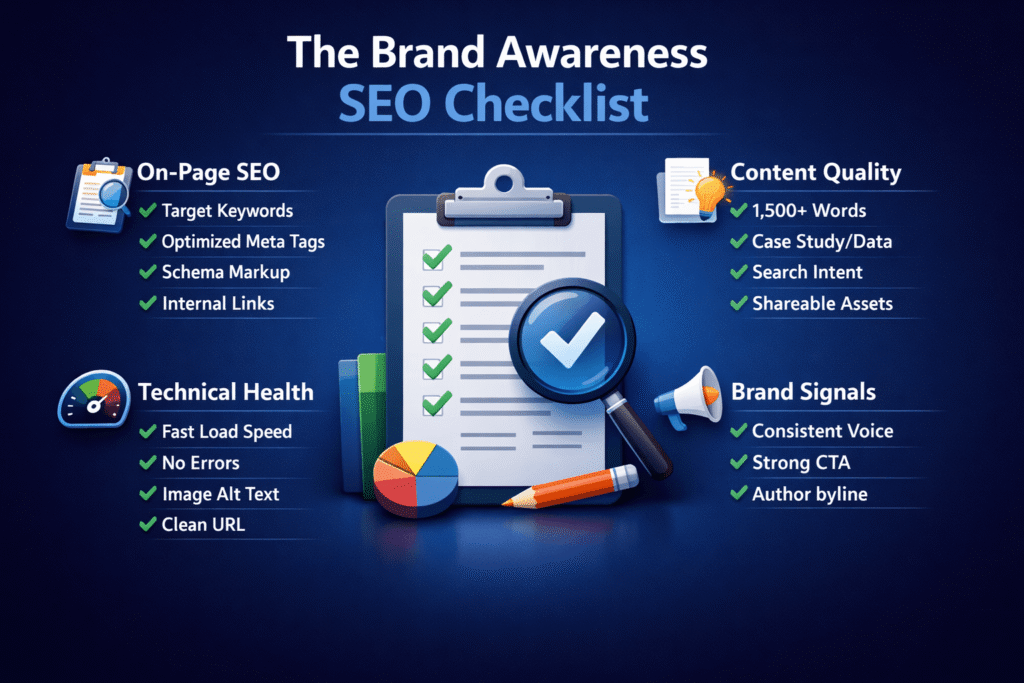
Use this before you publish any content or run any campaign:
On-Page SEO
- Target keyword in title, H1, intro, 3+ subheadings, and conclusion
- Meta description under 155 characters with clear click intent
- Schema markup added (Article, Organization, FAQ)
- Author bio with credentials and internal/external links
- Internal links to 3+ related pages
Content Quality
- Minimum 1,500 words with genuine depth
- Includes a real example, case study, or original data point
- Answers the full search intent (not just the surface question)
- Includes a shareable asset (checklist, table, template, or tool)
Technical Health
- Page loads in under 3 seconds on mobile
- No broken links or crawl errors on the page
- Image alt text includes descriptive keywords.
- URL is clean, short, and keyword-relevant
Brand Signals
- Consistent brand voice and tone throughout
- Clear CTA that connects content to a brand goal
- Published under a named author (not “admin” or anonymous)
Conclusion: Start Small, Build Something Lasting
Learning how to improve brand awareness with SEO isn’t about overnight results. It’s about building a system, one article, one backlink, one brand mention at a time until your name is the first that comes to mind in your space.
Start with topical authority. Fix your technical foundation. Create content worth sharing. Build links that build credibility. And stay consistent.
The brands that win in search over the next three years won’t be the ones with the biggest budgets. They’ll be the ones with the strongest, most consistent brand presence across every place their audience searches.
Frequently Asked Questions
How long does it take for SEO to improve brand awareness?
Can SEO help a brand-new business build awareness from scratch?
What’s the difference between SEO for traffic and SEO for brand awareness?
How do I measure brand awareness from SEO?
1. Branded search volume growth (people searching your name)
2. Direct traffic growth
3. Number of referring domains over time
4. Share of voice for your core topic cluster keywords