
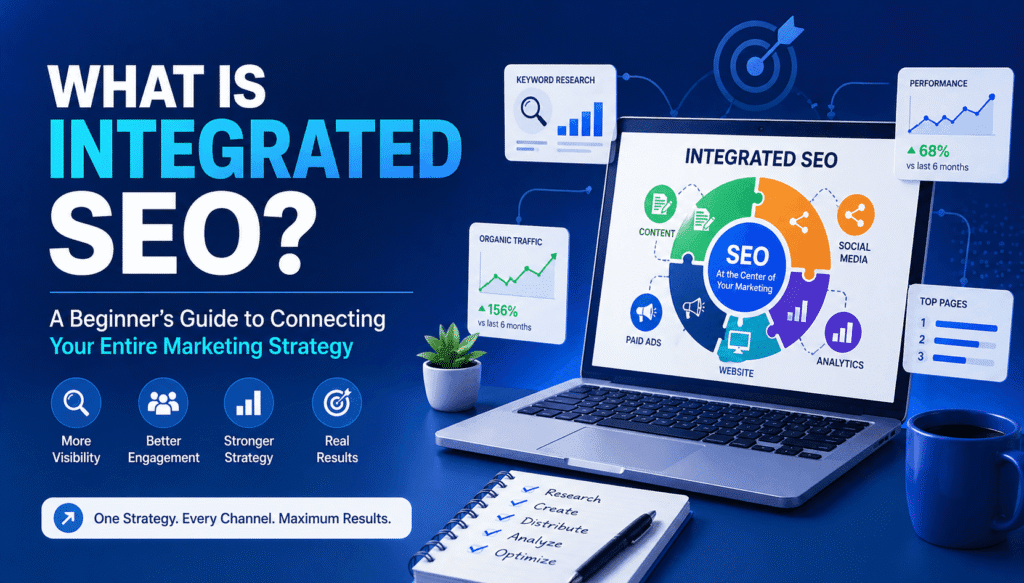
What Is Integrated SEO? A Beginner’s Guide to Connecting Your Entire Marketing Strategy
1. The Problem Most Businesses Don’t See
Here is something most people get wrong about SEO.
They think SEO is a task performed only after everything else is done.
Write the blog post first, then hand it off to someone for SEO optimization, and finally publish it.
Sound familiar?
This approach is one of the biggest reasons why so many businesses spend months creating content that never ranks and never brings in a single lead.
The truth is: SEO cannot work as an afterthought.
It needs to be woven into everything: your content, your ads, your website, your strategy. When that happens, the results are completely different.
That is what integrated SEO is. And by the end of this guide, you will understand exactly what it means, why it works, and how to start doing it even if you are a total beginner.
2. What Is Integrated SEO?
Integrated SEO means connecting your SEO strategy to every other part of your marketing so they work together rather than in separate silos.
Think of your marketing like a team sport.
If everyone plays for themselves, the team loses. But when every player knows the game plan and works toward the same goal, the team wins.
Integrated SEO is the game plan that connects your:
- Content team (what they write and why)
- Paid ads team (which keywords they bid on)
- Social media team (what they share and promote)
- Web developers (how the site is built and structured)
- Analytics team (what they measure and report)
When all of these teams use the same keyword insights and SEO data, your marketing gets dramatically more effective.
Simple definition: Integrated SEO = making SEO part of every marketing decision, not just a one-time task.
3. Why Does Integrated SEO Matter?
Let’s look at some numbers that put this into perspective.
- 68% of all online experiences begin with a search engine (BrightEdge, 2024)
- Organic search drives 44.6% of all B2B revenue more than any other channel (First Page Sage, 2025)
- SEO leads close at a rate of 14.6%, compared to just 1.7% for outbound marketing (HubSpot)
- Websites that use a structured, integrated content strategy rank for 3x more keywords on average than those that don’t
These are not small numbers.
If SEO drives this much business, it is too important to treat as an afterthought. It deserves to be at the center of your marketing, not on the sidelines.
The bottom line: When SEO is integrated, every piece of content you publish works harder. Every ad you run gets smarter. Every page on your website has a better chance of being found.
4. What Does “Integrated” Actually Mean in SEO?
The word integrated simply means “connected” or “combined.”
In SEO, it means your search strategy does not live in a bubble. It connects with everything else.
Here are three quick examples of what integration looks like in practice:
Example 1 — Content + SEO: Instead of writing a blog post and then “optimizing” it at the end, you start with keyword research. You find out what people are actually searching for. Then you write the article around that search demand. The SEO comes first, not last.
Example 2 — Paid Ads + SEO: Your PPC (pay-per-click) team discovers that the keyword “SEO tools for small business” converts really well in their ad campaigns. They share that data with your content team. The content team then creates an organic article targeting that exact keyword, doubling your visibility for a term you already know converts.
Example 3 — Social Media + SEO: You publish a new SEO-optimized blog post. Instead of letting it sit, your social media team shares key insights from it across LinkedIn, Instagram, and X. This drives a surge of traffic on day one, sending a positive signal to Google that the content is worth ranking.
Each of these is a form of SEO integration. None of them requires a big budget or a large team. They require connected thinking.
5. Integrated SEO vs. Traditional SEO
Here is a clear, side-by-side look at the difference:
| Traditional SEO | Integrated SEO |
| A separate task is done after the content is created | Built into every marketing decision from the start |
| Focused only on search rankings | Focused on traffic, leads, and real revenue |
| Keyword research is done occasionally. | Keyword insights shared across all teams |
| Blog posts optimized in isolation | All channels use the same keyword strategy. |
| Analytics is reviewed once a month. | Data is used continuously across the business. |
| Reactive fixing problems after they happen | Proactive SEO is part of the plan from day one. |
| One team’s responsibility | Everyone’s responsibility |
The key shift is this: traditional SEO optimizes pages. Integrated SEO optimizes your entire marketing strategy.
6. A Simple Real-Life Example
Let’s say you run a small business that sells handmade candles online.
With traditional SEO:
- You write a blog post about “the best candles for winter.”
- You add a few keywords at the end
- You publish it and wait
- Six months later, it ranks on page 4 and gets 11 visits a month
With integrated SEO:
- You start with keyword research and discover that “handmade soy candles for gifting” gets 900 monthly searches with very low competition
- You write a blog post built around that exact search intent, covering gift ideas, packaging, and why soy matters
- You share the post to your email list (20,000 subscribers) on publish day, driving 1,200 visits in the first 48 hours
- Your paid ads team runs a small campaign to the same page, testing which audiences convert best
- You use that conversion data to write two more articles on related keywords
- Within 10 weeks, your blog ranks on page 1 and drives 600+ organic visits per month consistently
Same business. Same product. Completely different result because SEO was integrated into the whole strategy, not tacked on at the end.
7. The 5 Core Pillars of an Integrated SEO Approach
You do not need to integrate SEO everywhere at once. Start with these five core pillars.
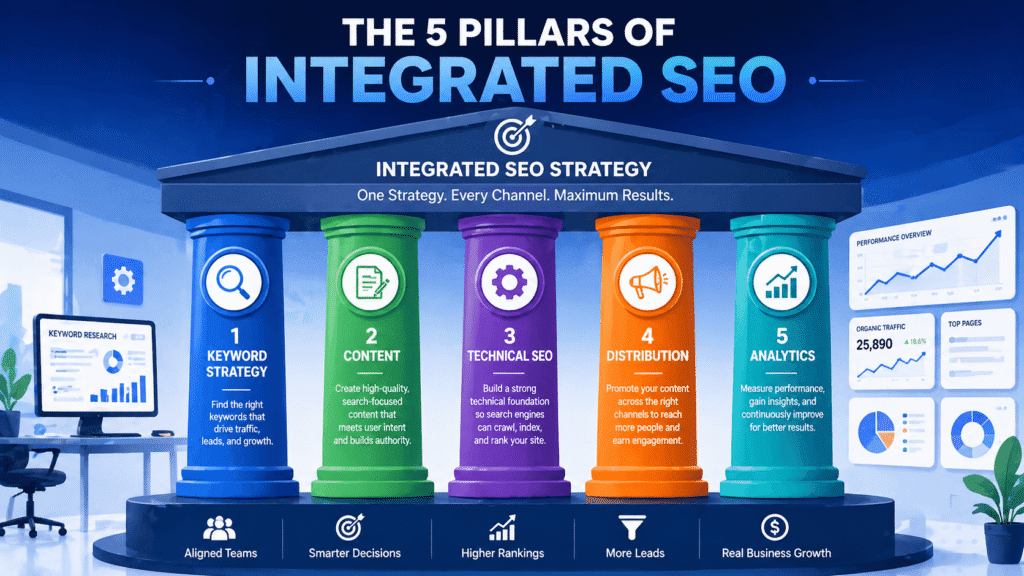
Pillar 1: Unified Keyword Strategy
One keyword research database that every team uses. Content, PPC, and social all work from the same insights, so your messaging is consistent, and your opportunities are never duplicated or missed.
Start with: A simple shared Google Sheet with your target keywords, their volume, difficulty, and which team is responsible for each one.
Pillar 2: Content Built Around Search Demand
Every piece of content, blog posts, landing pages, and product descriptions, starts with a keyword. Not the other way around.
This does not mean stuffing keywords into every sentence. It means choosing topics that real people are actively searching for, then writing the most helpful content on that topic.
Key question to ask before writing anything: “What is someone typing into Google right before they need this content?”
Pillar 3: Technical SEO Foundation
Even the best content will not rank if your website has technical problems.
The basics every site needs:
- Fast loading speed — pages should load in under 3 seconds on mobile
- Mobile-friendly design — more than 60% of all searches happen on a phone (Google, 2024)
- Clean URL structure — short, descriptive URLs that include your keyword
- No broken links — broken links waste Google’s crawl budget and frustrate readers
- XML sitemap — helps Google find and index all your pages
You do not need to be a developer to check these. Free tools like Google Search Console and PageSpeed Insights will show you exactly what needs fixing.
Pillar 4: Multi-Channel Distribution
Publishing content is only step one. Distribution is what gives it momentum.
Every piece of SEO content should be:
- Shared to your email list on publish day (for immediate traffic)
- Posted on social media platforms where your audience lives
- Mentioned in related older articles (internal links)
- Considered for promotion via a small paid campaign if the keyword is high-value
This multi-channel push sends Google a strong signal: people are interested in this content. That signal helps it rank faster.
Pillar 5: Consistent Measurement & Improvement
Integrated SEO is not a “set it and forget it” strategy. It needs regular check-ins.
The two free tools you need from day one:
- Google Search Console — shows you which keywords your pages appear for, how often they are clicked, and where they rank
- Google Analytics 4 — shows you how visitors behave once they arrive, and whether they convert
Review these every month. Update your best-performing articles every quarter. Replace underperforming content that has not ranked after 6 months.
8. How to Start Using Integrated SEO (Even as a Beginner)
You do not need a big team or a big budget. Here is a beginner-friendly starting point.
Week 1: Do your keyword research
- Sign up for a free Semrush or Ahrefs account (both offer free tiers)
- Type in your main topic and explore the keyword variations
- Find 5–10 keywords with low difficulty (under KD 30) and decent volume
Week 2: Map your content
- Group your keywords into topics
- Identify your main “pillar” topic and 3–5 supporting subtopics (clusters)
- Plan one article per keyword, starting with the easiest to rank
Week 3: Write your first piece of integrated content
- Start with the keyword. Structure your article around the search intent
- Write simply and clearly. Aim for a Grade 6–8 reading level
- Include internal links to related content on your site
- Add external links to credible sources (Google, Semrush, industry research)
Week 4: Distribute and track
- Share the article via email and social media on publish day
- Submit the URL to Google Search Console for indexing
- Set a reminder to review its performance in 30 days
That is it for the first month. Simple, focused, and repeatable.
For a full strategy framework, visit our pillar guide: The Complete Guide to SEO Integration →
9. Common Mistakes Beginners Make
Knowing what not to do is just as important as knowing what to do.
Mistake 1: Writing content without keyword research first. This is the most common beginner mistake: if no one is searching for your topic, your article will not generate organic traffic, regardless of its quality. Always start with keyword data.
Mistake 2: Targeting keywords that are too competitive. If you are just starting, do not try to rank for “SEO tips” or “digital marketing.” These keywords are dominated by large, authoritative sites with extensive backlink profiles. Strat targeting low-difficulty keywords first. Build your authority. Then go after bigger terms.
Mistake 3: Publishing and disappearing. SEO is a long-term strategy that requires consistent maintenance. Regularly review your performance, update content that is losing rankings, fix broken links, and refresh outdated statistics. Content that isn’t maintained will gradually lose its position in search results.
Mistake 4: Ignoring internal linking. Internal links between your own pages are free and powerful. Every time you publish something new, find 2–3 existing pages on your site and add a link to the new article. This passes authority and helps Google understand your site structure.
Mistake 5: Only measuring rankings. Rankings are just one signal. What really matters is: Is your content bringing the right visitors? Are those visitors converting? Track traffic, leads, and revenue, not just keyword positions.
10. Key Takeaways
SEO is not a final step; it is the foundation.
Treating SEO as an afterthought leads to content that never ranks or converts. Integrated SEO connects your entire marketing system.
Content, paid ads, social media, and analytics should all use the same keyword insights and goals. Keyword research drives everything.
Start with what people are searching for, then build content around that demand, not the other way around. Distribution is just as important as creation.
Publishing alone is not enough. Amplify content through email, social media, and internal links to gain traction. Data should guide every decision.
Use tools like Google Search Console and Google Analytics 4 to continuously refine your strategy. Focus on low-competition opportunities first.
Early wins build authority and momentum, making it easier to rank for more competitive keywords later. SEO success comes from consistency, not shortcuts.
Regular updates, optimization, and measurement are what sustain long-term growth. Integrated SEO improves real business outcomes, not just rankings.
The goal is traffic, leads, and revenue, not vanity metrics.



3 Comments