
What Is Business Scaling? A Complete Beginner’s Guide (2026)
What Is Business Scaling?
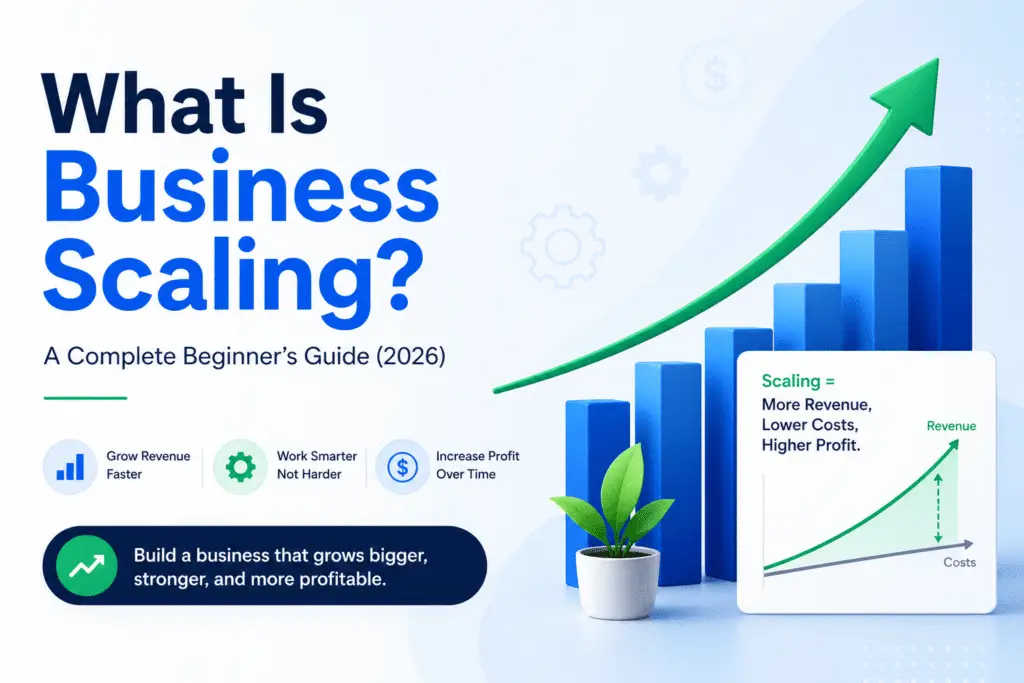
You have probably heard the word “scaling” thrown around a lot. Investors say they want to fund businesses that can scale. Successful founders say scaling changed everything for them. But what does it actually mean, and how is it different from just growing your business?
This guide explains what business scaling is, in plain English. No jargon. No fluff. By the end, you will understand exactly how scaling works, why it matters, and whether your business is ready for it.
| What Is Business Scaling? |
| Business scaling is the process of growing a company’s revenue significantly without increasing its costs at the same rate. A scaling business often earns much more, without needing to spend proportionally more to do so. The result is that profit margins improve as the business gets bigger, rather than staying flat. |
What Does Scaling Mean in Business?
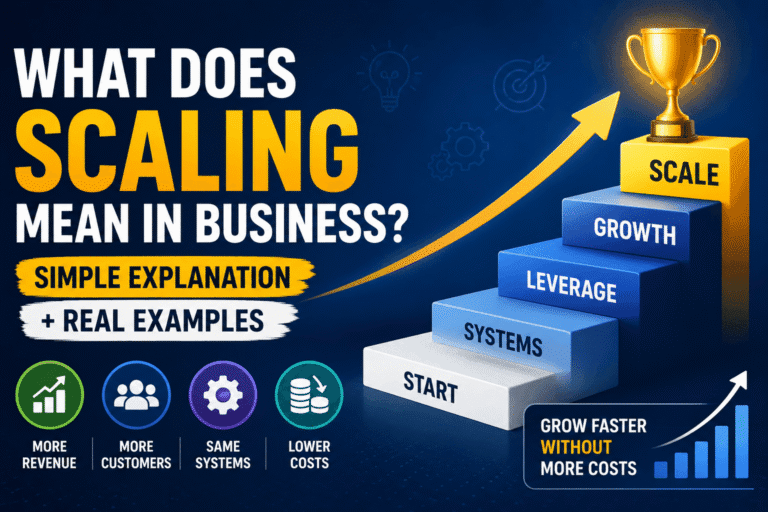
The word “scaling” comes from the Latin scalae, meaning stairs or a ladder. In business, it refers to a company’s ability to climb higher (generate more revenue) without each step getting proportionally harder to take.
Here is the most important sentence in this article:
| “Scaling is when your revenue curve rises faster than your cost curve.” |
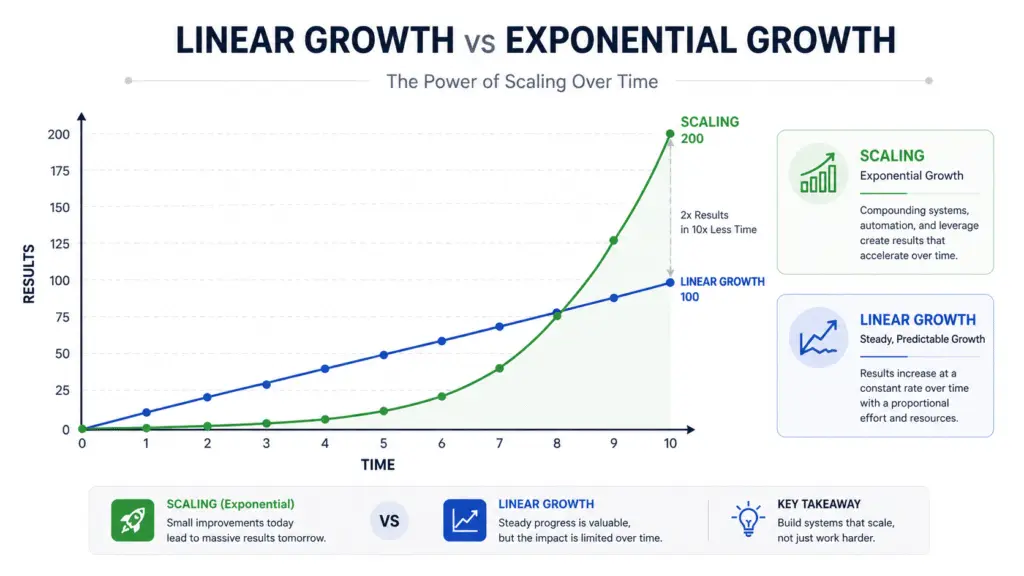
The OECD, the world’s leading economic research organization, formally defines a scale-up as a business growing at 20% or more per year for at least three consecutive years. But you do not need to hit that bar to be scaling. The principle applies to any business building systems, people, and processes to grow revenue faster than costs
What Does Scaling Look Like in Real Life?
The easiest way to understand scaling is through a side-by-side example. Read this carefully; it captures the essential difference.
| A Tale of Two Businesses |
| Maria’s Marketing Agency (Growing): Maria’s Marketing Agency (Growing): Maria takes on 5 new clients. She hires 5 new account managers. Revenue doubles, and her costs also double. Profit margin stays flat. She is growing, not scaling. |
| James’s SaaS Tool (Scaling): James adds 200 new customers to his software platform. Server costs rise by 2%. Revenue rises by 40%. Profit margin improves. He is scaling. |
| The key difference: Maria needs more people to earn more money. James’s systems earn more money without proportionally more people. |
Notice that James did not work ten times harder. He did not hire 10 times as many people. His systems did the work. That is the core idea behind scaling: building a business that becomes more efficient and more profitable as it gets bigger.
Business Scaling vs Business Growth: The Key Difference
This is one of the most commonly misunderstood distinctions in business. Growth and scaling are related, but they are not the same thing, and confusing them leads to expensive mistakes.
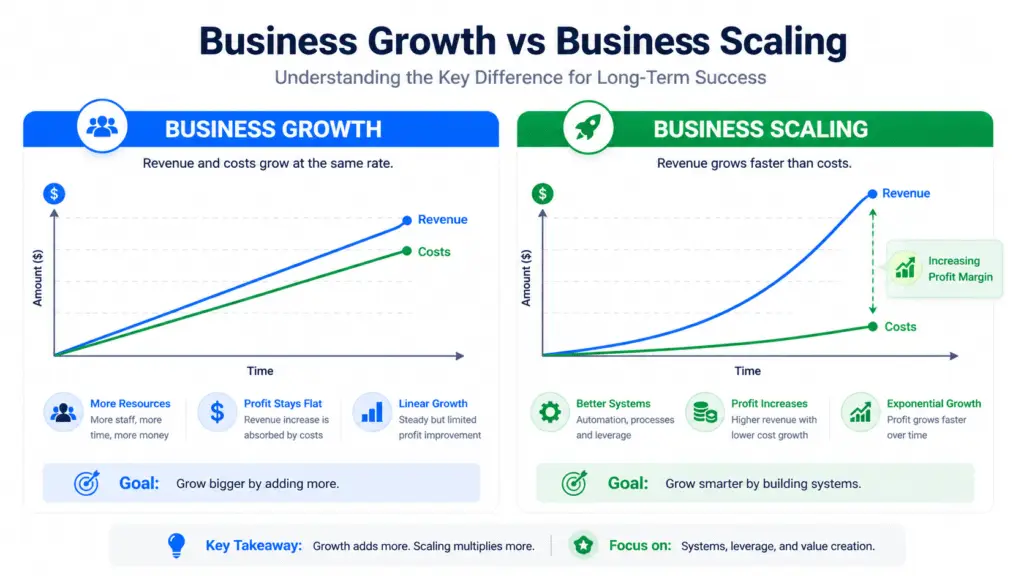
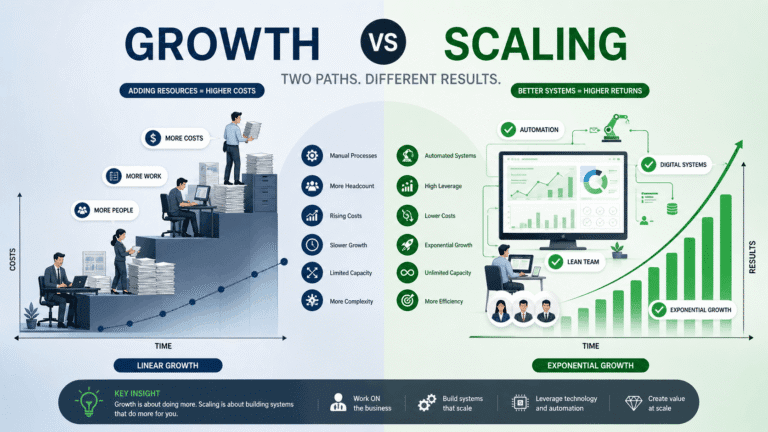
Business growth means your revenue increases as you add more resources. More staff, more locations, more expenses. Revenue and costs grow roughly together. It is linear, predictable, and the necessary foundation most businesses build before they can scale.
Business scaling means your revenue increases faster than your costs, because your systems and infrastructure can handle significantly more output without proportional new investment.
| Business Growth | Business Scaling | |
| Revenue increases… | Proportionally with costs | Faster than costs non-linearly |
| Costs increase… | In line with revenue | Marginally — much slower |
| Headcount | Grows with every new client | Grows slowly, rarely 1:1 |
| Requires… | More resources & people | Better systems & processes |
| Risk level | Lower, more predictable | Higher, but higher reward |
| Best for… | Early-stage businesses | Proven, ready-to-scale businesses |
| Important Note |
| Most businesses need to grow before they can scale. Growth builds the foundation — the proven product, the repeatable process, the real customers — that scaling then accelerates. Trying to scale without that foundation is one of the leading reasons businesses fail when they expand. |
Why Does Business Scaling Matter?
Scaling is not just for Silicon Valley startups or billion-dollar companies. It matters for any business owner who wants to build something that is sustainable, profitable, and not entirely dependent on their personal effort.
The Numbers Tell a Clear Story
According to the SBA Office of Advocacy, there are over 33 million small businesses in the United States alone, making up 99.9% of all U.S. businesses. Yet only a small fraction ever scales meaningfully.
The OECD’s 2025 research on scaling SMEs found that for every 10 jobs created by large firms, growing small and medium-sized businesses create 16 additional jobs — making scaling businesses among the most powerful drivers of economic growth globally.
A business with 10–19 employees generates on average $2.16 million in annual revenue, compared to just $387,000 for a business with 1–4 employees. That 5× difference is driven largely by scalable systems and operations.
Three Reasons Scaling Matters More Than Ever in 2026
- Automation is cheap and accessible. AI-powered tools that once required entire departments, such as customer service, marketing, and data analysis, are available to any business at a low cost. The technological barrier to scaling has never been lower.
- Competition is global. Your competitors are not just local anymore. Lean, scalable businesses can offer more, faster, at lower cost. Standing still is falling behind.
- Founders deserve freedom. A business that only works because of your personal involvement is not an asset; it is a job. Scaling is how you build a business that generates value without requiring you to be involved in every decision.
The Three Core Ingredients of a Scalable Business
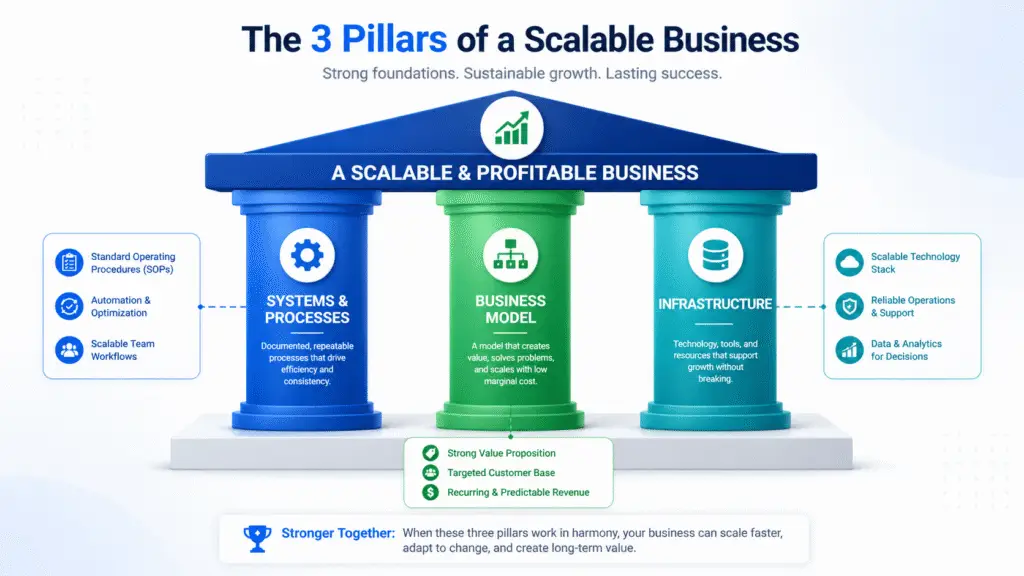
Not every business is scalable by default. But most businesses can build toward scalability by developing three core elements:
1. Scalable Systems and Processes
A scalable business has documented, repeatable processes called Standard Operating Procedures (SOPs) that any trained team member can follow. This removes the founder as the bottleneck and allows the business to deliver consistently, even as it grows.
If your business only works because of your personal knowledge or presence, it is not yet scalable. The first step is documenting what you do and how you do it.
2. A Scalable Business Model
Some business models are structurally more scalable than others. SaaS software, digital products, subscription services, licensing, and e-commerce platforms all have low marginal costs; each new customer costs very little to serve.
Labour-intensive custom services are less naturally scalable, but they can be made more scalable through productisation, converting bespoke work into standardised, repeatable packages, and technology.
3. Scalable Infrastructure
As a business grows, its technology, supply chain, and team structure need to handle increased demand without breaking. A business that collapses under 3× its current load is not ready to scale. Building infrastructure slightly ahead of current demand, rather than constantly playing catch-up, is the discipline that separates scaling businesses from struggling ones.
What Business Scaling Is NOT
There are several common misconceptions about scaling that lead founders down the wrong path:
- Scaling is not the same as growing fast. A business can grow very quickly while still spending proportionally more on every new unit of revenue. Fast growth without improving unit economics is not scaling.
- Scaling is not just about raising money. More capital does not automatically produce scale. Capital accelerates what is already working; it does not create scalability where none exists.
- Scaling is not only for tech companies. Service businesses, retail businesses, professional firms, and local businesses can all scale — though the methods differ from software companies.
- Scaling is not always the right next step. Scaling before a business has a proven product, repeatable sales process, and positive unit economics is one of the most common causes of business failure.
Is Your Business Ready to Scale? A Quick Self-Assessment
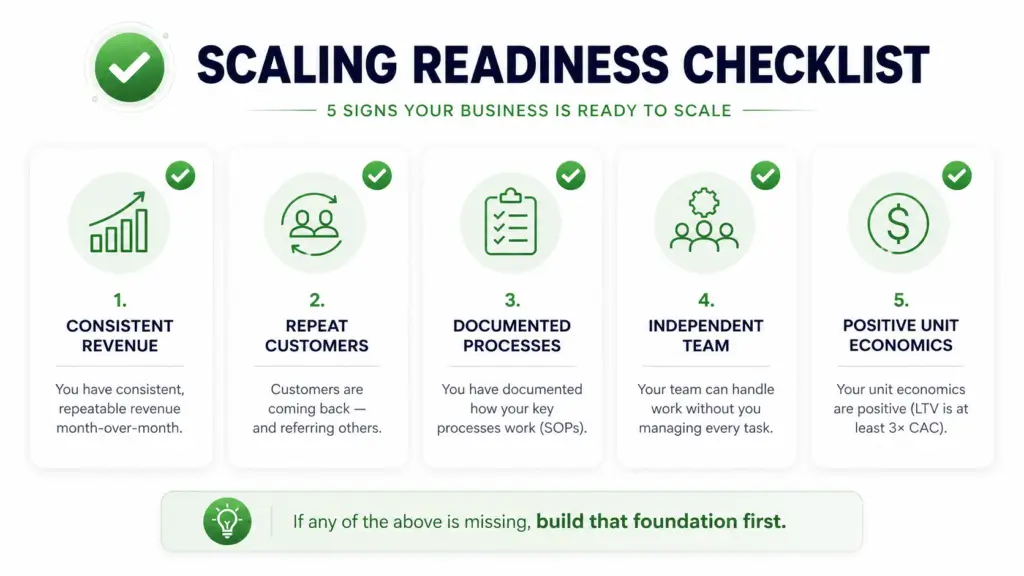
Before thinking about scaling, be honest with yourself about whether the foundations are in place. Use this quick checklist:
| Are You Ready to Scale? |
| ✅ You have consistent, repeatable revenue month-over-month |
| ✅ Customers are coming back — and referring others |
| ✅ You have documented how your key processes work (SOPs) |
| ✅ Your team can handle work without you managing every task |
| ✅ Your unit economics are positive (LTV is at least 3× CAC) |
| If any of the above is missing, build that foundation first. |
If you checked all five boxes, it’s great. You likely have the foundations to begin scaling. If not, do not worry. The next step is building those foundations first. That is not a failure; it is exactly what the most successful scaling businesses did before they accelerated.
Key Takeaways
| Summary: What Is Business Scaling? |
| Definition: Business scaling is growing revenue faster than costs — making the business more profitable and efficient as it gets bigger. |
| Scaling ≠ Growth: Growth adds revenue and costs proportionally. Scaling adds revenue disproportionately faster than costs. |
| Foundation first: Scaling without a proven product, repeatable process, and positive unit economics accelerates problems, not growth. |
| Three core ingredients: Scalable systems, a scalable business model, and scalable infrastructure. |
| Any business can move toward scaling by building better systems, leveraging technology, and designing a model where each new customer costs less to serve. |
Frequently Asked Questions
What does business scaling mean?
Is scaling the same as growing a business?
When should a business start scaling?
Can a small or solo business scale?
What is a scalable business model?
What to Read Next
| Part of the Business Scaling Content Series |
| Pillar Page: The Complete Guide to Business Scaling (2026) — Start here for the full overview. |
| Next in Cluster 1: Business Scaling vs Business Growth — The Critical Difference → |
| Also in this series: What Does Scaling Mean in Business? · Signs Your Business Is Ready to Scale |
| External Sources & Further Reading (E-E-A-T) 1. OECD — Unleashing SME Potential to Scale Up (2025) — Defining scale-up benchmarks for SMEs globally. 2. Harvard Business Review — The Five Stages of Small Business Growth — Churchill & Lewis (1983), a foundational study on growth stages. 3. Shopify — How to Scale a Business: 6 Steps for Growth (2026) — Practical e-commerce scaling guide from a leading platform. 4. Upwork — How to Scale a Business in 2026 — Nine proven strategies for business scaling. 5. SBA Office of Advocacy — Small Business Facts & Data — U.S. government primary source for small business statistics. |
2 Comments