
Business Scaling vs Business Growth: The Critical Difference (2026)
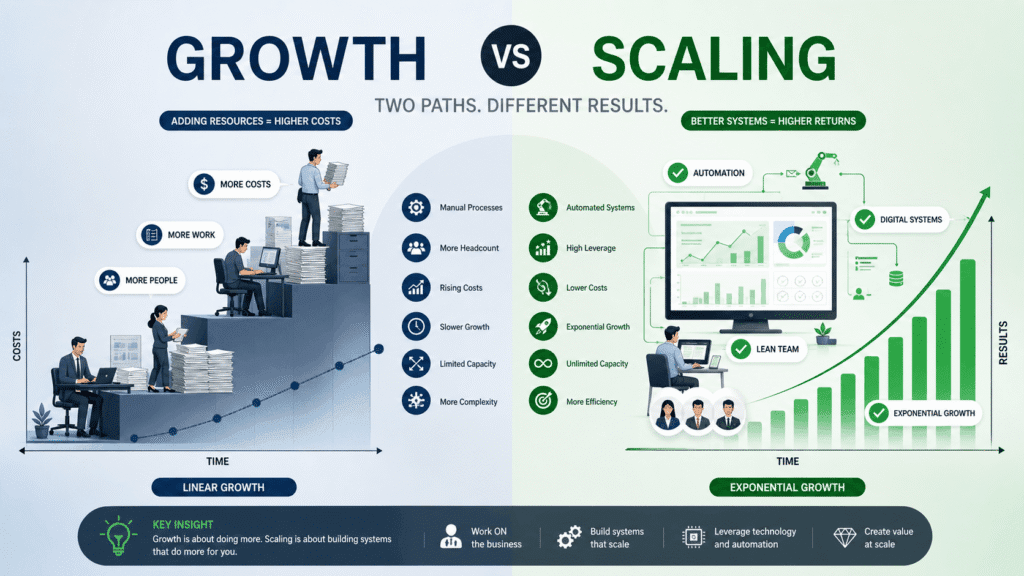
Here is a mistake almost every founder makes at some point: they use the words ‘scaling’ and ‘growing’ as if they mean the same thing. They do not. And confusing the two can cost you time, money, and real opportunities.
Understanding the difference between business scaling and business growth is not just a vocabulary exercise. It is one of the most practically useful distinctions in business strategy because it changes how you spend your money, who you hire, what systems you build, and when you push the accelerator.
According to Wise Business Finance, many business leaders use these two terms interchangeably, but the strategies, costs, and outcomes they produce are fundamentally different. Getting this wrong at the wrong moment is one of the leading causes of expensive scaling failures.
In this article, you will learn exactly what each term means, how they compare side by side, when to use each strategy, the myths that trip founders up, and how to know which one your business needs right now.
| What Is the Difference? |
| Business growth means adding revenue by adding more resources, like staff or tools, in step with sales, so costs rise too. |
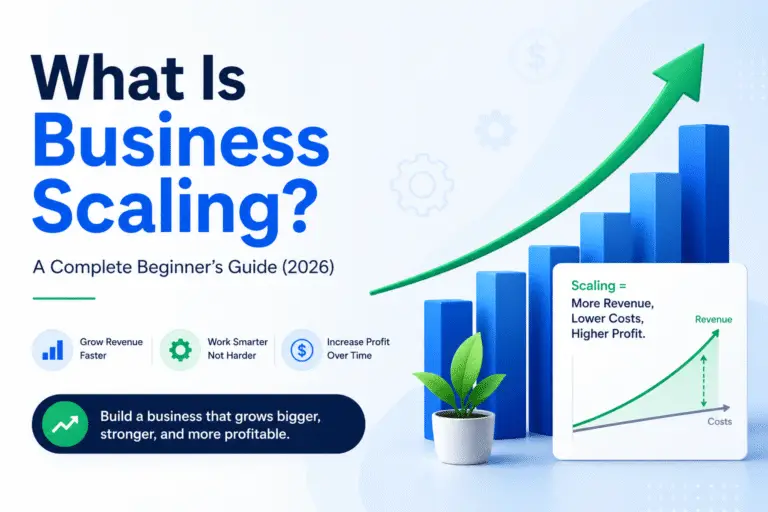
| Business scaling means adding revenue faster than costs by leveraging systems, technology, and processes. Revenue and costs diverge. |
| The simplest test: If you double your revenue and also double your costs, you have grown. If you double your revenue and barely increase your costs, you have scaled. |
Defining Each Term Clearly
Before we compare them, let’s nail down what each term actually means.
| Business Growth Revenue and costs grow together. You add resources to earn more. Hiring stays in step with revenue. More predictable and lower risk. Essential foundation for most businesses. | Business Scaling Revenue grows faster than costs. Systems do the heavy lifting. Hiring grows much more slowly. Higher risk — higher reward. Requires proven foundations first. |
Think of it this way: Growth is adding more floors to a building. Scaling is designing the building so that adding floors becomes cheaper and easier each time.
Why This Difference Matters
This is not just theory. The financial impact of understanding this distinction is enormous.
Data from the Tailor Brands Small Business Report 2025 shows a stark picture:
- A solo business earns, on average, $49,489/year.
- A business with 1–4 employees earns $387,000/year — 8× more, but with proportionally more cost.
- A business with 10–19 employees earns $2.16 million/year — a 5× jump from the tier below, driven by scalable systems and processes, not just headcount.
According to industry projections, 85% of fast-growth companies will depend on scalable digital infrastructure by 2026. The businesses that understand the difference between growing and scaling and apply the right strategy at the right time are the ones that reach those higher revenue tiers.
And the downside of confusing the two? 70% of startups struggle to scale — often because they tried to scale before they had a proper growth foundation, or because they confused fast growth with efficient scaling.
Business Scaling vs Growth: A Full Side-by-Side Comparison
Here is the complete comparison across every dimension that matters to a business owner:
| Factor | Growth | Scaling |
| What drives it? | Adding more resources | Better systems & processes |
| Cost vs revenue | Both rise proportionally | Revenue rises faster than costs |
| Headcount growth | 1 new hire per new client | 1 hire can serve many new clients |
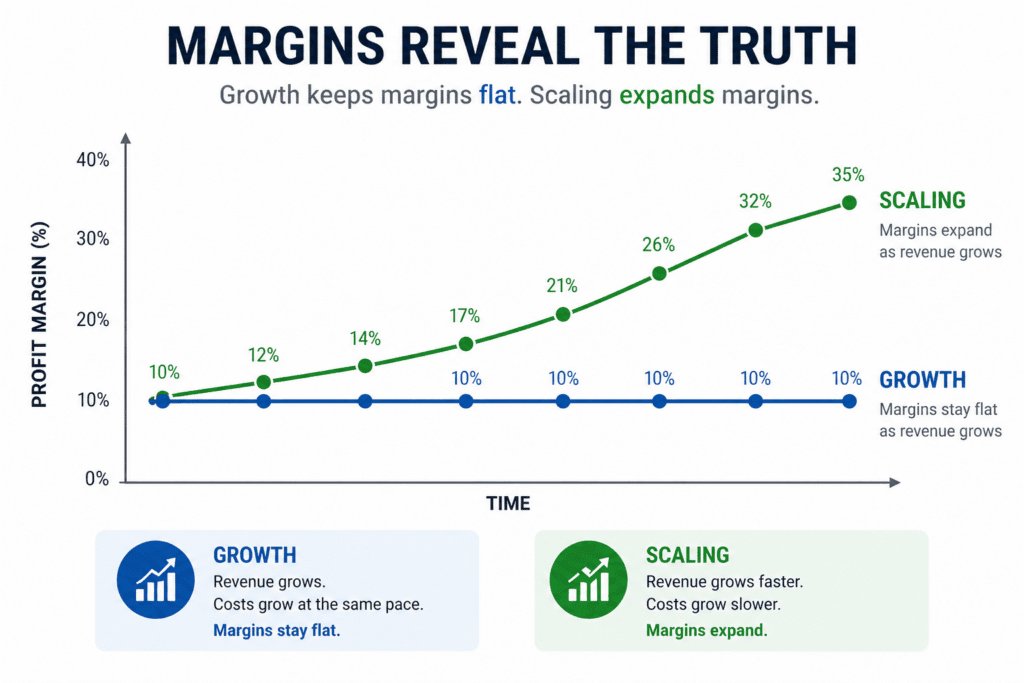
| Profit margin | Stays roughly the same | Improves as revenue grows |
| Capital required | High — continuous investment | Lower once systems are built |
| Speed of results | Predictable and steady | Slower to start, then exponential |
| Best applied when | Building your foundation | Foundation is proven & stable |
| Risk level | Lower and manageable | Higher, but higher reward |
| Editor’s Insight |
| In my experience advising founders, the biggest aha moment is when they realise that margin is the true signal. If your profit margin is flat or shrinking as you grow, you are growing, not scaling. If your margin is expanding as revenue increases, you are scaling. Track this number obsessively. |
Real-World Examples: Growing vs Scaling in Action
Let’s make this concrete. Here are three business types in which the same scenario played out as growth versus scaling:
| If Growing… | If Scaling… |
| A pizza shop opens a second location. It hires more staff, buys more equipment, and leases a new space. Revenue doubles — costs double too. | The same shop launches online ordering and a loyalty app. Delivery revenue increases 60% with no new location, no new staff. |
| A consultant takes on 5 more clients. She hires 5 junior consultants to serve them. Margin stays flat. | The same consultant records a course and sells it to 500 people. She earns more while working the same hours. |
| A SaaS startup hires 3 support agents every time it adds 100 users. Costs grow with revenue. | The same startup builds a self-serve knowledge base. 200 new users get onboarded with zero new support staff. |
Notice the pattern. In every scaling scenario, the business found a way to decouple revenue from the time, headcount, or physical resources required to generate it. That is the hallmark of true scaling.
When Should You Grow and When Should You Scale?
This is the practical question most founders actually want answered. The honest answer: it depends on where your business currently sits.
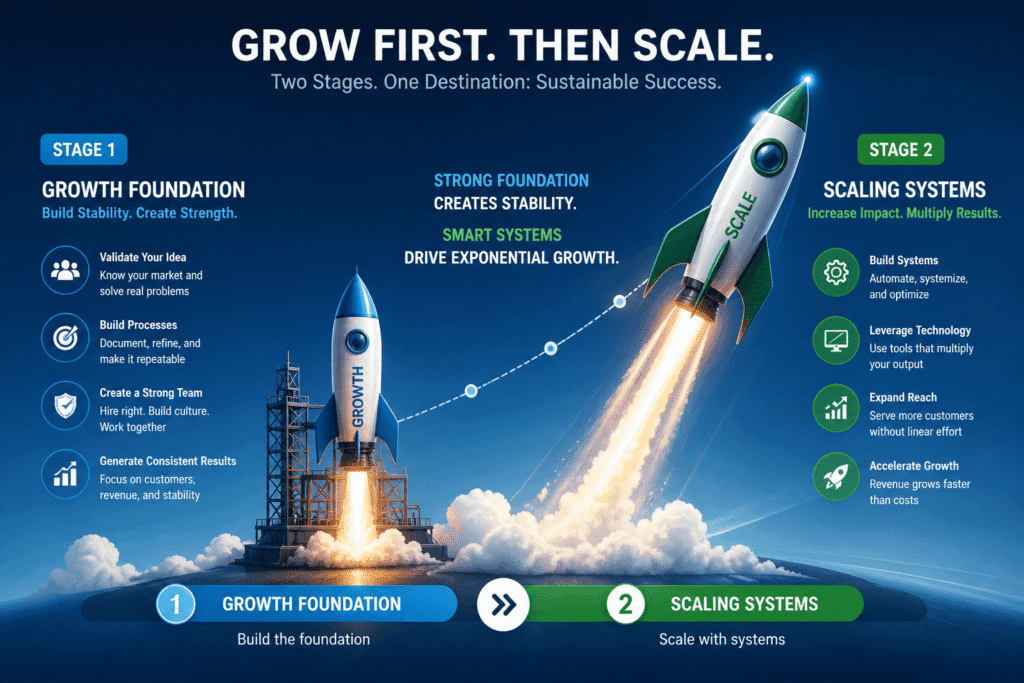
Most businesses should grow first and scale second. You need a proven product, a repeatable process, and real customers before you put fuel in the engine. Scaling a business with shaky foundations does not fix the foundation — it amplifies the cracks.
| Choose Growth First You don’t yet have a proven product-market fitYour revenue is unpredictable month-to-monthYou rely on yourself for most key decisionsYou haven’t documented your core processesYour customer retention rate is below 70% | You Are Ready to scale revenue. It is consistent and growing steadily. You have a repeatable, documented sales process. LTV is at least 3× your customer acquisition cost. Your team can operate without you for 2+ weeks. Systems are in place — not just people |
The rule of thumb used by most experienced investors and operators: if you cannot clearly explain your customer acquisition cost, your lifetime value, and your core delivery process, you are not ready to scale. Grow first.
5 Myths About Scaling vs Growth (And the Real Truth)
These misconceptions trip up even experienced founders:
| Common Myth | The Real Truth |
| Myth: Scaling just means growing faster | Truth: Speed is not the point. Scaling means growing more efficiently — revenue increasing faster than costs. A slow-scaling business can still outperform a fast-growing one. |
| Myth: You need to scale as soon as possible | Truth: Scaling too early is one of the top reasons businesses fail. Build your foundation first — proven model, repeatable systems, strong unit economics. |
| Myth: Growth and scaling are interchangeable | Truth: They are fundamentally different strategies. Confusing them leads to wrong decisions at critical moments in a business’s lifecycle. |
| Myth: Scaling requires outside investment | Truth: Many businesses scale profitably using only operational cash flow. Capital accelerates scaling — it does not create it. |
| Myth: Only tech companies can truly scale | Truth: Every type of business can move toward scale with the right systemisation, productisation, and technology — including service businesses and local shops. |
How to Shift from a Growth Mindset to a Scaling Mindset
Making the transition from growth-mode to scaling-mode is as much a mindset shift as it is a strategic one. Here is how successful founders make the change:
1. Stop hiring for every new problem
In growth mode, the answer to every capacity problem is a new hire. In scaling mode, the first question is: Can a system, process, or piece of technology solve this before we hire?
2. Document everything
If a task requires your personal knowledge to complete it, that task cannot scale. Start by documenting your most critical and most repetitive processes. Every SOP you write is a step toward a scalable business.
3. Obsess over unit economics
Calculate your customer acquisition cost (CAC) and customer lifetime value (LTV). The moment your LTV: CAC ratio exceeds 3:1 and your payback period drops below 18 months, you have the financial green light to begin scaling.
4. Invest in leverage, not just labour
Leverage means tools, systems, and people who can multiply your output — not just add to it. A great operator (COO), a solid CRM, and an automated onboarding system will do more for your ability to scale than three additional generalist hires.
5. Think in systems, not tasks
Ask yourself: ‘How do we build this so it works 10x at the same cost?’ rather than ‘How do I get this done today?’ That single question is the beginning of a scaling mindset.
Key Takeaways
| Summary: Scaling vs Growth |
| Growth = proportional. Revenue and costs rise together. Essential for building foundations. |
| Scaling = disproportional. Revenue rises faster than costs. Requires proven foundations first. |
| The margin test: If margins are flat as you grow, you are growing. If margins expand as revenue grows, you are scaling. |
| Timing matters: Scaling too early is one of the most common and most expensive business mistakes. |
| Both are valid and necessary — but they demand different strategies, different capital, and different thinking. |
| The goal: Build the growth foundation first, then design the systems that let you scale it. |
Continue Reading
| Business Scaling Content Series — Navigate the Full Library |
| ✦ Pillar Page: The Complete Guide to Business Scaling (2026) → Start here for the full overview |
| ✦ Article 1: What Is Business Scaling? A Complete Beginner’s Guide → |
| ✦ You are here: Business Scaling vs Business Growth — The Critical Difference |
| ✦ Article 3: What Does Scaling Mean in Business? (Coming next →) |
| ✦ Article 4: Signs Your Business Is Ready to Scale → |
Frequently Asked Questions
Is scaling better than growing?
Can a business grow and scale at the same time?
How do I know if my business is ready to shift from growing to scaling?
Does scaling always require technology?
What is the biggest mistake founders make with scaling vs growth?
| External Sources & E-E-A-T References 1. Wise (Business Finance) — Growth vs Scaling: What It Really Means to Grow a Business Efficiently — Authoritative plain-English distinction between growth and scaling. 2. Runn.io — Don’t Confuse Scaling & Growing: Here’s the Difference — Operational breakdown with real examples of each strategy. 3. McKinsey & Company — Scaling a Business: Creating Sustainable Growth — Research on what differentiates scaling businesses from growing ones. 4. Tailor Brands Small Business Report 2025 — Small Business Statistics & Revenue Data — Primary data source for revenue benchmarks at different business sizes. 5. SBA Office of Advocacy — Small Business Facts — U.S. government primary source for small business statistics. 6. Harvard Business Review — The Five Stages of Small Business Growth — Churchill & Lewis foundational study on growth vs scaling readiness. |

One Comment