What Is Brand Awareness? (Definition, Examples & 9 Proven Ways to Measure and Grow It)
Brand Fundamentals
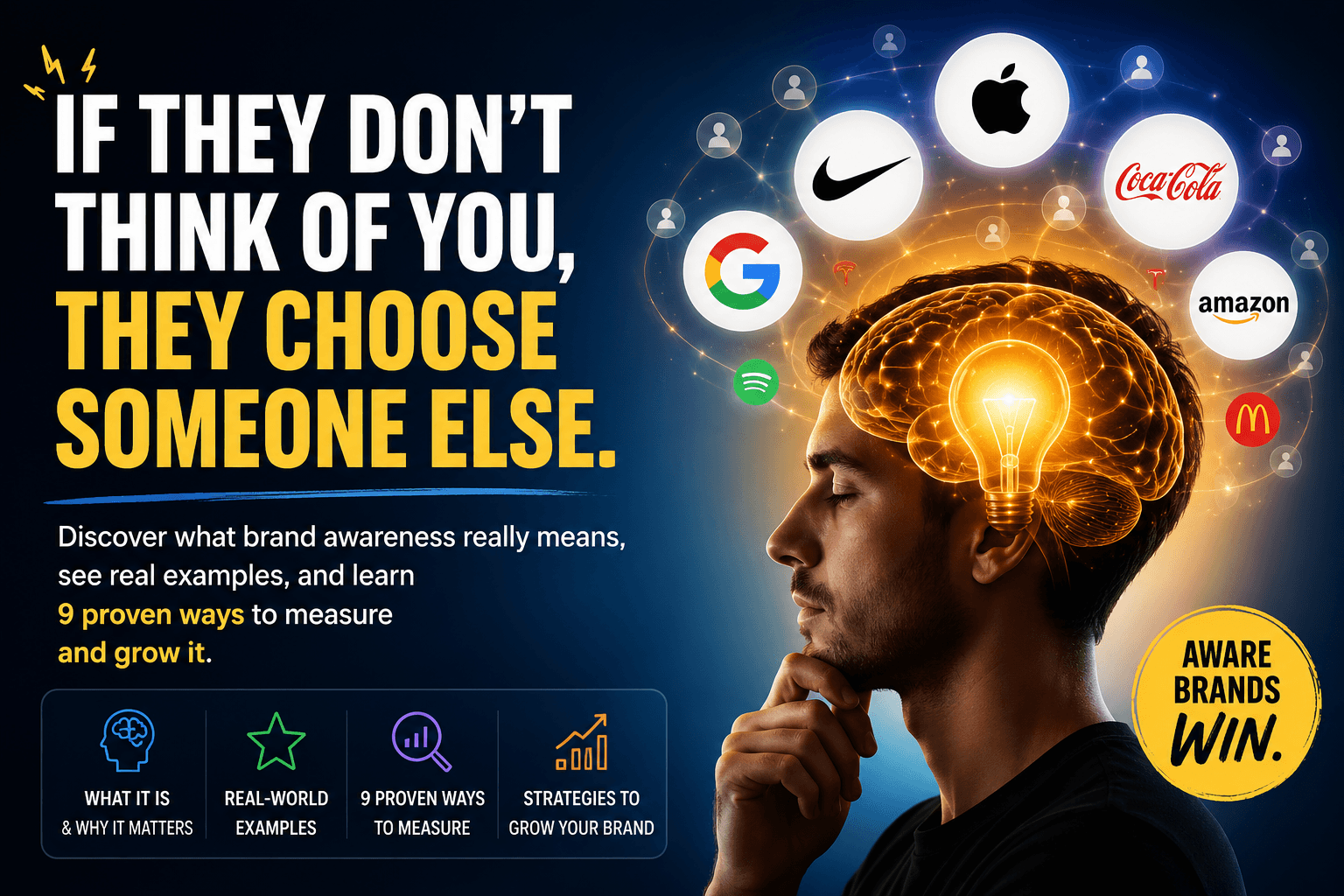
What Is Brand Awareness? Definition, Examples, and How to Measure It
Quick Definition
Brand awareness is the degree to which consumers recognize and remember a brand — its name, visual identity, products, and reputation — within their market. It is the first and most fundamental stage of the customer journey: before anyone buys from you, they need to know you exist.
Brand Awareness, Defined
Brand awareness measures how familiar your target audience is with your business. It goes beyond simply knowing a company’s name — it encompasses whether consumers associate the brand with specific products, qualities, values, or experiences when they encounter it.
There are two commonly recognized levels of brand awareness.
Unaided awareness (also called top-of-mind awareness) means a consumer mentions your brand unprompted when asked about a category. If someone asked “name a search engine” and your first answer is Google, that is unaided brand awareness at its peak.
Aided awareness means a consumer recognizes your brand when shown its name or logo, even if they would not have recalled it independently.
For most businesses, the practical goal is somewhere between these two points: ensuring that when a potential customer encounters a problem your product solves, your brand comes to mind before your competitors do.
Brand awareness operates differently from brand equity or brand loyalty. Awareness is a prerequisite — you cannot build loyalty or equity for a brand that consumers have never heard of. It is always the first metric that matters, regardless of industry or company size.
Brand Awareness vs. Brand Recognition
These two terms are often used interchangeably, but they describe different cognitive processes. Understanding the distinction helps you target the right marketing investment.
| Dimension | Brand Awareness | Brand Recognition |
|---|---|---|
| What it measures | Familiarity with the brand, its offerings, and its reputation | Ability to identify the brand from a visual or auditory cue |
| Triggered by | A need or product category (unaided recall) | Seeing a logo, color, jingle, or packaging (aided recall) |
| Stronger indicator of | Purchase consideration and long-term loyalty | Visual consistency and marketing reach |
| Harder to build | Yes — requires sustained, multi-channel presence | No — achievable with consistent visual branding alone |
| Example | “I need running shoes — Nike comes to mind” | “I recognize that swoosh logo as Nike” |
Recognition is a component of awareness, not a replacement for it. A brand with high recognition but low awareness might have a distinctive logo that consumers see regularly, but no meaningful understanding of what that brand offers or why it deserves consideration. True awareness encompasses both.
Why Brand Awareness Matters in Digital Marketing
In markets with many competing options, consumer decision-making is heavily shaped by familiarity. Research consistently shows that people are more likely to choose, trust, and pay more for brands they recognize — even when objective product differences are minimal.
In digital marketing specifically, brand awareness affects performance across almost every channel:
- Search: Familiar brands earn higher click-through rates at the same or lower ranking positions, because users gravitate toward names they trust.
- Email: Recognized sender names see meaningfully higher open rates than unknown ones, regardless of subject line quality.
- Paid advertising: Brand-aware audiences convert at higher rates and lower cost-per-acquisition because they already trust the business before they see the ad.
- Content marketing: Content from a recognized brand earns more shares, backlinks, and time-on-page than identical content from an unknown source.
- Word of mouth: Consumers only recommend brands they can name and describe clearly — awareness is the prerequisite for referrals.
As search engines integrate AI-generated answers and voice search grows, brand recall becomes more valuable than ever. An AI-generated result or voice assistant response will often cite or favor brands with strong digital authority — companies that search engines have already learned to associate with expertise and trust in a given category.
Real-World Examples of Brand Awareness Done Right
The brands with the highest global awareness did not get there by accident. They built recognition through consistent visibility, a clear identity, and presence across every channel their audience uses. Here is what that looks like in practice:
What smaller brands can learn from this
None of these companies started with global name recognition. They built it through repetition, consistency, and presence in the places their audience spent time. For smaller businesses, the same principles apply at a smaller scale: be findable in your niche, be consistent in your messaging, and be present wherever your target audience searches for answers.
A local service business that ranks consistently for relevant search queries, maintains an updated Google Business Profile, and publishes helpful content about its specialty will build meaningful brand awareness within its market — even without a national marketing budget.
The mechanism is the same whether the scale is local or global: repeated, relevant exposure creates familiarity, and familiarity builds trust.
How to Measure Brand Awareness: 9 Key Metrics
Brand awareness is not purely abstract — it can and should be tracked with measurable indicators. The following metrics each capture a different dimension of how visible and memorable your brand is within your target market. No single metric tells the full story; the most useful approach tracks several of these together.
How often users search for your brand name or branded phrases directly in search engines. Tracked via Google Search Console. Growth here is one of the clearest signals of rising awareness.
How many times your website appears in search results, regardless of whether users click. High impressions across non-branded queries indicate you are reaching new audiences effectively.
Visitors who type your URL directly or use a bookmark. This is one of the strongest signals of brand recall — users who know your address well enough to skip the search engine entirely.
How often your brand name appears in social conversations, including posts, comments, and shares. Tools like Mention or Brand24 track this across platforms in real time.
Your brand’s visibility compared to competitors in a given market or keyword space. Calculated as your brand’s mentions or impressions divided by total market mentions. A higher share signals stronger presence.
How often other websites link to or reference your brand. This reflects your reputation and authority within your industry, and it is also a direct input into search engine rankings.
The percentage of users who click your search result after seeing it. Brands with stronger awareness typically achieve higher CTR at the same ranking position — familiarity overcomes the friction of not being first.
Total unique users exposed to your brand across all channels — search, social, display, and email combined. Reach measures how widely your message is spreading beyond your existing audience.
Bounce rate, average session duration, and pages per session reflect how users behave once they find you. High engagement suggests your brand is delivering on the expectation its awareness has created.
The SEO Connection: How Search Visibility Builds Brand Awareness
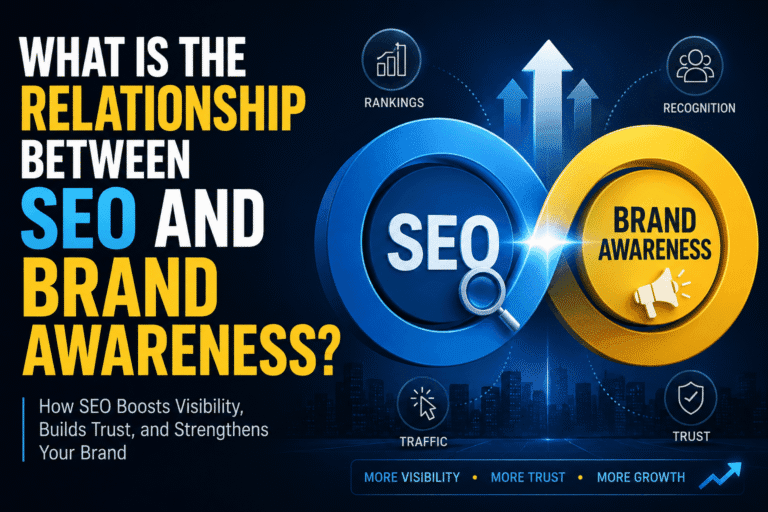
SEO and brand awareness are not separate strategies — they reinforce each other in ways that compound over time. Every time your website appears in a search result, it is an impression: a moment where a potential customer encounters your brand name, even if they do not click.
When a user searches for information in your category and repeatedly sees your brand in the results — for multiple searches, over weeks or months — familiarity builds. That familiarity is what eventually turns a stranger into a visitor, and a visitor into a customer. This is why investing in SEO is not only about driving traffic; it is also one of the most cost-effective long-term methods for building brand awareness at scale.
The relationship also runs in the other direction. As your brand awareness grows, your branded search volume increases — and higher branded search volume signals authority to search engines. Familiar brands earn more clicks at every ranking position, accumulate more natural backlinks, and see stronger engagement metrics. Each of these signals, in turn, strengthens organic search performance.
Businesses that combine SEO with consistent brand building consistently outperform those that treat them as separate activities. The compounding effect — where search visibility builds awareness, and awareness improves search performance — is one of the most powerful dynamics in digital marketing.
Frequently Asked Questions
What is brand awareness in simple terms?
Brand awareness is how easily people recognize and remember your business. A brand with high awareness is one consumers think of naturally when they need a product or service in your category — without needing a reminder or advertisement to prompt the recall.
What is the difference between brand awareness and brand recognition?
Brand recognition means a consumer can identify your brand when they see it — a logo, color scheme, or packaging style. Brand awareness is broader: it includes recognition plus an understanding of what the brand stands for, what it offers, and why it is worth considering. Awareness leads; recognition confirms.
Why is brand awareness important for a business?
Consumers consistently choose brands they recognize over unfamiliar alternatives, even when both offer similar quality at similar prices. High brand awareness shortens the sales cycle, increases customer trust, improves click-through rates in search results, and lowers acquisition costs over time as organic recognition replaces paid promotion.
How do you measure brand awareness?
The most reliable brand awareness metrics include branded keyword search volume, direct website traffic, organic search impressions, social media mentions, share of voice, and backlink growth. Each metric captures a different dimension of how visible and memorable your brand is. No single metric is sufficient on its own — track several together for the clearest picture.
Can small businesses build brand awareness on a limited budget?
Yes. SEO-driven content, local search optimization, and consistent social media activity are all effective, low-cost awareness channels. Small businesses often build stronger recognition by focusing on a specific niche or geographic area first, establishing authority within a focused audience before expanding reach. Consistency over time matters more than budget size.