Table of Contents
- What Is Business Scaling
- Business Scaling vs Business Growth: The Critical Difference
- Why Business Scaling Matters More Than Ever in 2026
- The 5 Stages of Business Growth
- Signs Your Business Is Ready to Scale
- Core Business Scaling Strategies
- Operations: Building Systems That Scale
- Finance: Funding and Managing Your Scale-Up
- People: Building the Team That Grows with You
- Common Business Scaling Mistakes to Avoid
- Key Metrics to Track When Scaling
- Business Scaling by Industry
- Your Business Scaling Action Plan
- Conclusion
What Is Business Scaling?
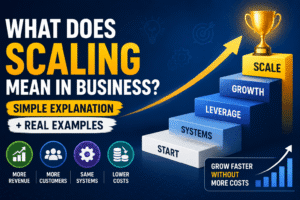
Business scaling is the process of growing a company’s revenue and capacity without increasing its costs at the same rate. In other words, a scaling business earns significantly more without spending proportionally more to do so.
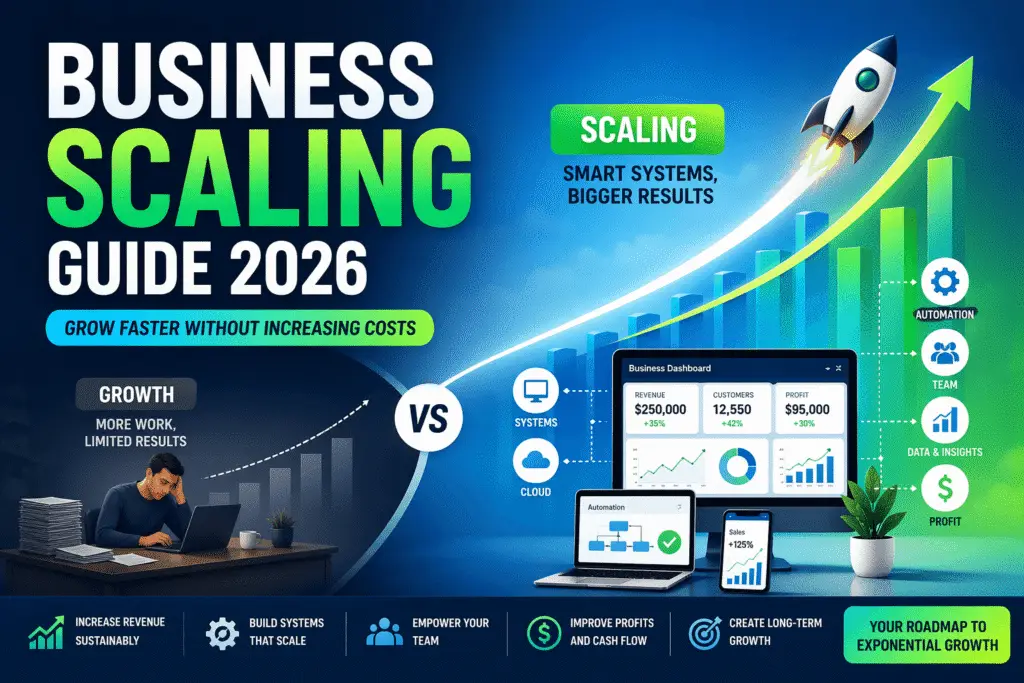
This is what separates scaling from ordinary growth. When you add a new client and need to hire someone to serve that client, your business is growing. When you add ten new clients and your existing team and systems absorb them without breaking, your business is scaling.
The clearest definition: scaling is when your revenue curve rises faster than your cost curve. curve
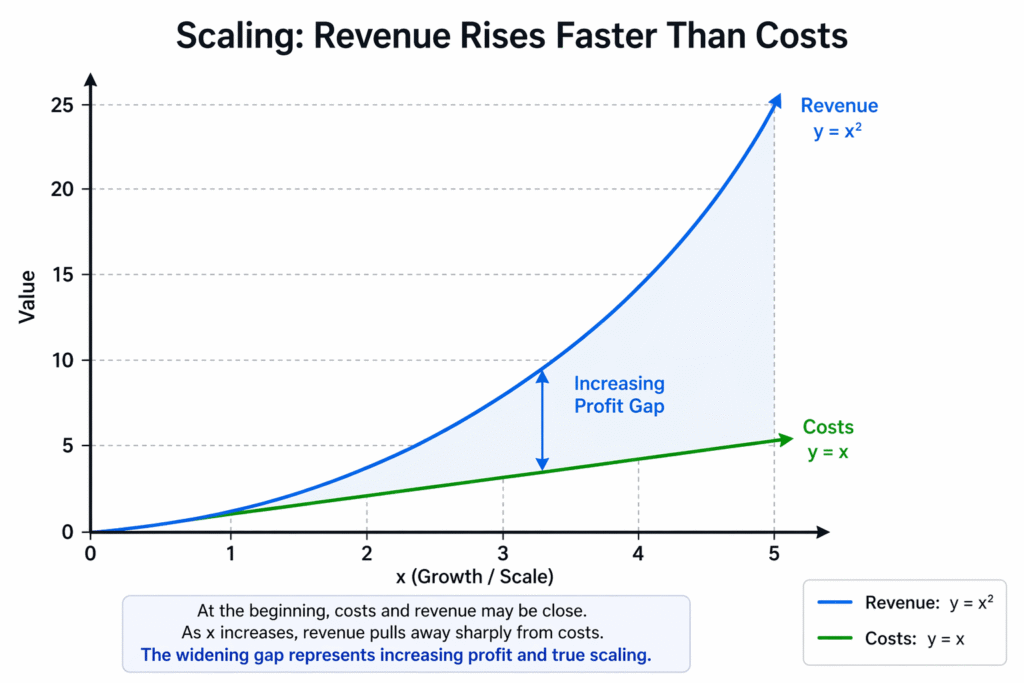
Here is a simple example. A solo consultant who earns €5,000 per client and takes on five more clients this year has grown. But a SaaS company that adds 200 new customers to an existing platform without rebuilding anything, that company is scaling. The cost to serve customer 201 is almost zero, yet the revenue keeps climbing.
Key distinction: Growth adds resources proportionally. Scaling adds revenue disproportionately. Both are valid strategies, but they require completely different approaches.
Business Scaling vs Business Growth: The Critical Difference
Most entrepreneurs use the terms “scaling” and “growing” interchangeably. They are not the same thing, and confusing them often leads to poor strategic decisions.
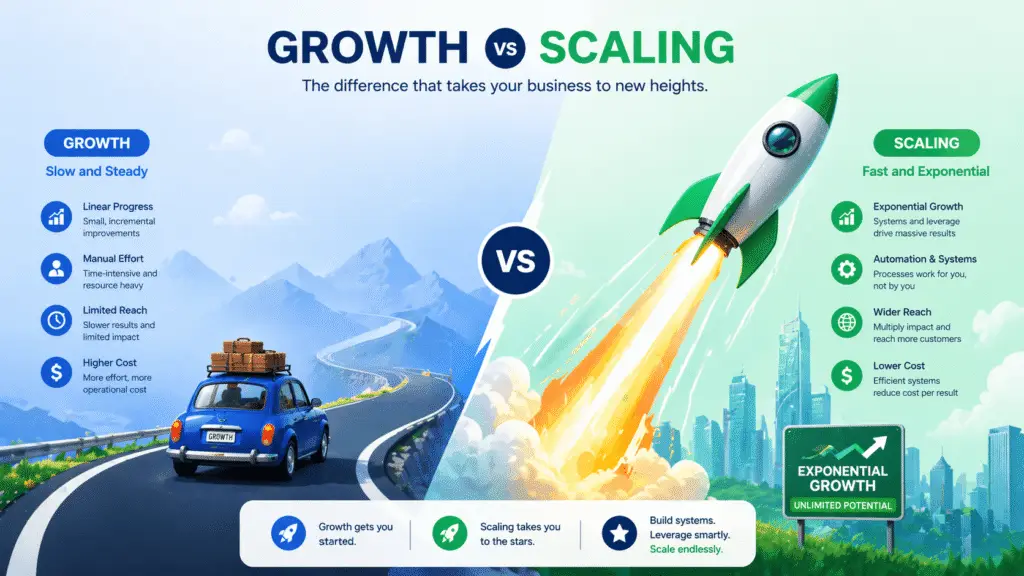
Business growth means increasing revenue by increasing resources in kind. This includes hiring more people, taking on more clients, or opening more locations. In this model, revenue and costs rise together at a similar rate. Growth is linear. It is necessary and the foundation most businesses need before they can scale.
Business scaling means increasing revenue by multiplying outputs from existing resources. The same team, the same systems, and the same infrastructure are used to serve many more customers and generate significantly higher revenue. Scaling is non-linear and does not depend on proportional increases in cost.
Growth vs Scaling Comparison
| Factor | Growth | Scaling |
| Revenue | Increases proportionally | Increases disproportionately |
| Costs | Increase proportionally | Increase marginally |
| Headcount | Grows with revenue | Grows more slowly |
| Requires | More input (time, money, effort) | Better systems and leverage |
| Risk | Lower | Higher |
| Reward | Steady | Exponential |
The important nuance is that most businesses need to grow before they can scale. You need a proven product, a repeatable sales process, a reliable delivery mechanism, and real customers before you can put rocket fuel on the engine. Scaling without a solid foundation is the fastest way to destroy a business.
Research published in Harvard Business Review on the five stages of small business growth confirms this. Businesses that attempt to scale before establishing operational foundations consistently fail at a higher rate than those that grow methodically first.
| Source: Harvard Business Review Churchill & Lewis (1983): “The Five Stages of Small Business Growth” — the landmark study that mapped how businesses evolve from existence through maturity, and why each stage demands a different leadership and operational approach. Read the original HBR article ↗ |
Why Business Scaling Matters More Than Ever in 2026
The business environment in 2026 has made efficient scaling not just desirable, but necessary for long-term survival.
The numbers tell a stark story. There are now over 33.2 million small businesses in the United States alone. With 99.9% of all U.S. companies classified as small businesses, competition for customers, talent, and market share has never been more intense. Meanwhile, only 16% of small businesses in the US ever scale to employ more than one to nineteen workers, meaning the vast majority stay small, flat, and vulnerable.
| Data Source: U.S. Small Business Administration. All small business statistics cited in this section are drawn from the SBA Office of Advocacy 2024 Annual Report and Tailor Brands Small Business Report 2025 — both primary, government-verified sources updated annually. SBA Office of Advocacy ↗ · Tailor Brands Small Business Statistics 2026 ↗ |
The businesses that scale share common traits:
- Businesses with 10–19 employees generate on average $2.16 million in annual revenue, compared to $387,000 for those with 1–4 employees
- Companies using multiple digital tools experience measurably higher revenue growth and faster expansion
- 74% of small business owners expect revenue growth in 2026, but only those with scalable systems will actually achieve it sustainably
Beyond the numbers, three macro-forces are making business scaling more achievable than at any point in history:
Automation and AI. Tools that once required entire departments, such as customer support, marketing, data analysis, and scheduling, can now be handled by affordable software. This is one of the strongest tailwinds for scaling businesses today.
Global reach through digital. 51% of U.S. business is now conducted online. A business that once served a single city can now serve an entire continent using the same infrastructure.
Documented frameworks. From EOS (Entrepreneurial Operating System) to OKRs to Scaling Up, the playbooks for scaling have never been more accessible or better tested.
| Scaling Frameworks External Resources The frameworks referenced throughout this guide are independently documented and widely adopted: • EOS (Entrepreneurial Operating System) by Gino Wickman: EOSWorldwide.com ↗ • OKRs (Objectives and Key Results): WhatMatters.com ↗ • Scaling Up by Verne Harnish: ScalingUp.com ↗ |
The question is not whether you should scale. The question is whether you are building a business that can.
The 5 Stages of Business Growth
Understanding where your business currently sits is the most important prerequisite to scaling intelligently. Harvard Business Review’s landmark research identified five distinct growth stages, each with different challenges, priorities, and scaling readiness.
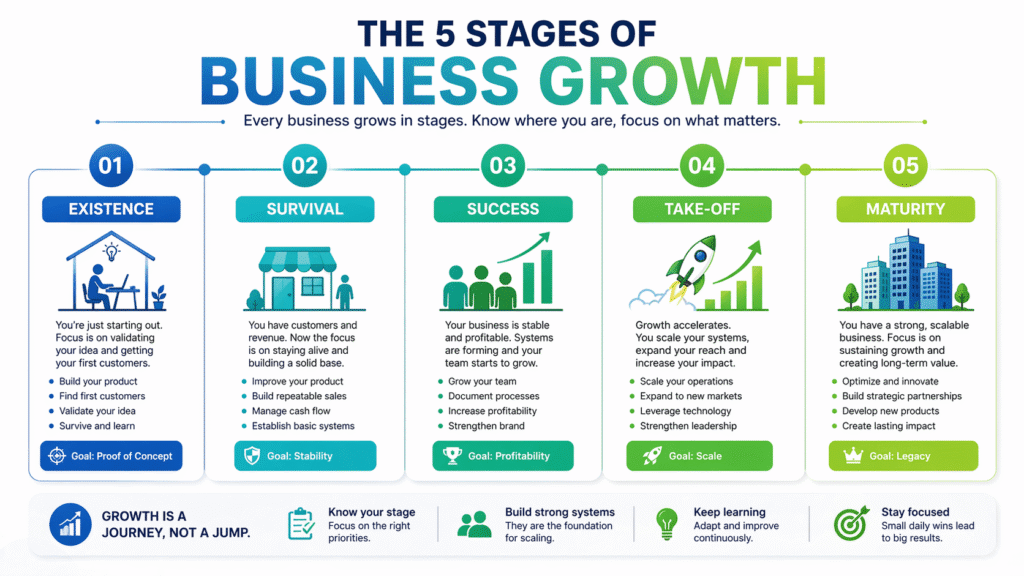
Stage 1: Existence
The business is fighting to survive. The owner is doing everything. The central challenge is finding enough customers to validate the product and generate cash. Scaling is not yet relevant; survival is. At this stage, the goal is proof of concept.
Scaling readiness: 0/5. Focus entirely on product-market fit and first revenue.
Stage 2: Survival
The business has customers and generates revenue. It covers costs. But it is still entirely dependent on the founder. Systems are improvised, not designed. Every problem is a fire drill. Scaling here would pour fuel on a fire.
Scaling readiness: 1/5. Begin documenting what works; that documentation is your future system.
Stage 3: Success
The business is profitable and somewhat stable. The owner can step back without everything collapsing. A small team exists. Processes are beginning to emerge. This is the critical decision point: consolidate and stay here or prepare to scale.
Scaling readiness: 3/5. This is where the groundwork for scaling gets laid.
Stage 4: Take-Off
The business is actively scaling. Revenue is growing faster than costs. Delegation is happening. The primary challenge shifts from “how do we grow?” to “how do we maintain quality and culture as we grow?” Cash flow becomes the biggest constraint because growth consumes cash before revenue catches up.
Scaling readiness: 5/5. This is the scaling stage. Most of this guide applies here.
Stage 5: Maturity
The business has scaled successfully. The challenge now is maintaining entrepreneurial agility within a larger, more bureaucratic structure. Scaling here means entering new markets, launching new products, or scaling the scaling.
Scaling readiness: 4/5. Scaling is ongoing but takes different forms.
How to Identify Your Current Stage
Where are you? Be honest. Most entrepreneurs overestimate their stage. The businesses that scale successfully are the ones that do the unglamorous Stage 2–3 work, building systems, documenting processes, and developing repeatable operations, before they try to accelerate.
Signs Your Business Is Ready to Scale
Not every business is ready to scale. Scaling too early is one of the most common and most destructive mistakes founders make. Here are the signals that indicate genuine scaling readiness.
1. You have consistent, predictable revenue. If your monthly revenue varies wildly, your business model is not yet stable enough to scale. Look for at least three to six months of consistent growth before accelerating.
2. You have a proven, repeatable sales process. You know exactly how you acquire a customer, how long it takes, and what it costs. Customer acquisition cost (CAC) is measurable and defensible.
3. Customers come back and refer others. High retention and organic referrals signal genuine product-market fit. Scaling a business with poor retention is like filling a leaking bucket; you will spend all your energy replacing the customers you lose.
4. You have documented processes. If your business only works because of your personal involvement, you do not have a business; you have a job. Documented SOPs (Standard Operating Procedures) are the foundation of a scalable operation.
5. Your team can function without you for extended periods. This is the acid test. Take a two-week holiday with minimal contact. If the business runs, you have the early foundations of a scalable team. If it collapses, you need to invest in people and systems before you scale.
6. Your unit economics are positive. Lifetime value (LTV) is meaningfully higher than customer acquisition cost (CAC). A LTV: CAC ratio of at least 3:1 is the standard benchmark. If you are acquiring customers at a loss and banking on future revenue to justify it, scale only with extreme caution and clear evidence that the unit economics improve with volume.
7. Your infrastructure can absorb 3x the current load. Not just your team, your technology, your supplier relationships, your delivery systems. If doubling your customers would break your operations, you are not ready to scale.
Core Business Scaling Strategies
Once readiness is established, the next question is: which strategy fits your business model? There is no universal approach. The right scaling strategy depends on your industry, your product, your market, and your capital position.
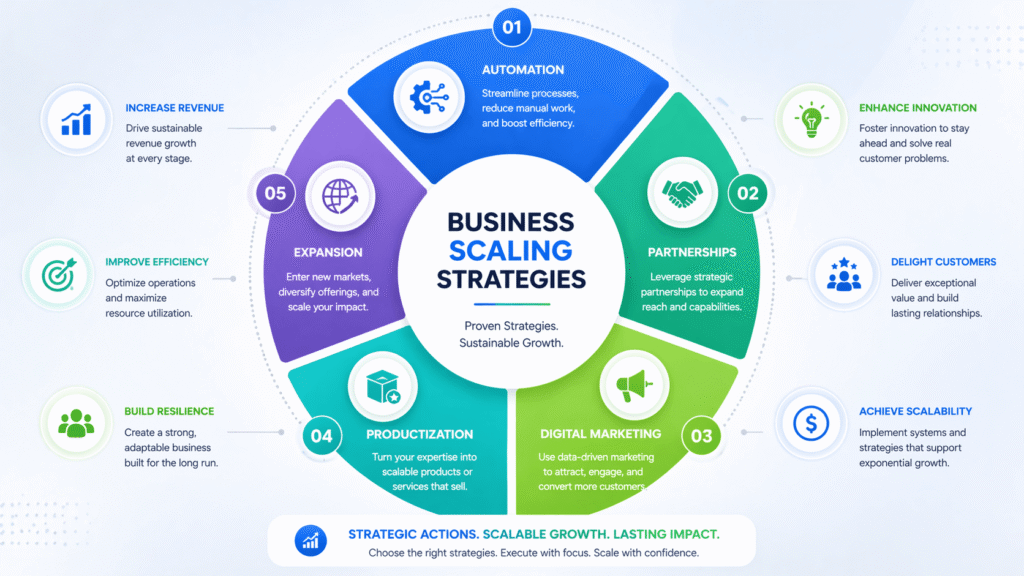
1. Product or Service Productisation
Converting a bespoke, custom service into a standardised product with fixed scope, fixed price, and a repeatable delivery process is one of the most powerful scaling strategies for service businesses. Instead of custom-quoting every engagement, you sell a defined package that your team can deliver consistently without the founder’s involvement.
2. Digital and Technology Leverage
Replacing manual, human-dependent processes with technology is the fastest route to scalable unit economics. A business that uses automation for onboarding, customer communication, invoicing, and reporting can handle 10x the customers without 10x the headcount. In 2026, with AI-powered tools available at every price point, there is no excuse for any scaling business to be doing manually what software can do.
3. Geographic Expansion
If you have a proven model in one market, scaling it to new geographies such as new cities, new countries, or new channels is a classic scaling play. The key is ensuring the model is genuinely reproducible before expanding, not assuming it will work because it worked in the original market.
4. Channel Multiplication
Rather than scaling through a single sales channel, high-growth businesses typically diversify across multiple acquisition channels simultaneously. Organic SEO, paid acquisition, partnerships, referrals, and direct sales all working together create compounding growth that no single channel can achieve alone.
5. Strategic Partnerships and Distribution
Partnering with businesses that already have the customers you want and who benefit from your product or service allows you to access audiences you could not build on your own. White-labelling, affiliate arrangements, and distribution partnerships can accelerate scaling with very little additional cost.
6. Franchise or Licensing Models
For businesses with a strong, replicable model, franchising or licensing allows other operators to scale your brand and systems with their own capital. This is how brands like McDonald’s, Subway, and thousands of smaller businesses have scaled globally while managing capital risk.
Operations: Building Systems That Scale
Operational infrastructure is where most scaling efforts succeed or fail. You cannot scale chaos. The businesses that scale well invest obsessively in their operating systems before they need them.
Document Everything
The most important operational move for any pre-scale business is building a living library of Standard Operating Procedures (SOPs). Every repeatable task in your business, from how you onboard a new client to how you handle a customer complaint, should have a documented process that any competent team member can follow.
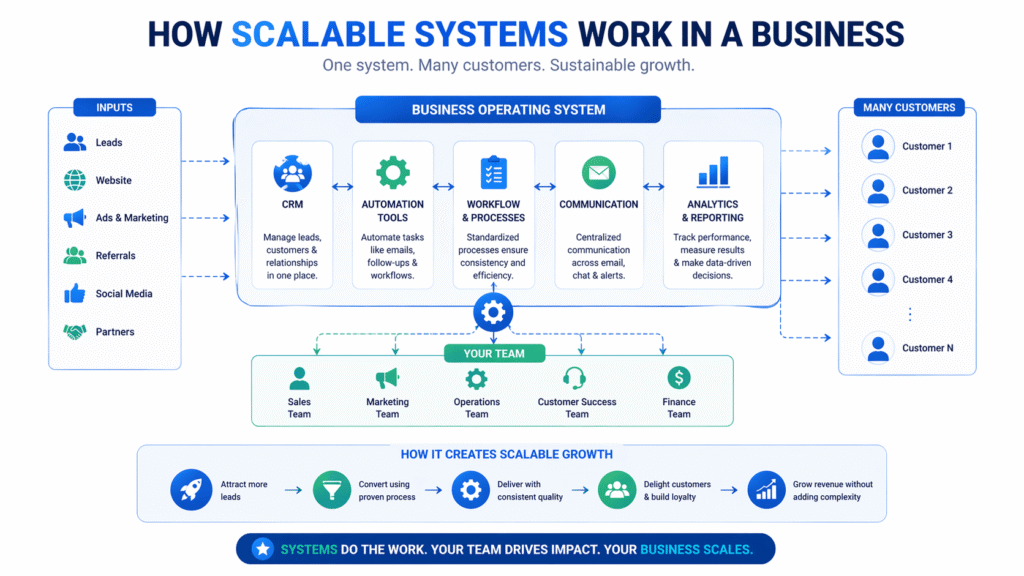
SOPs serve three critical functions in a scaling business. They remove the founder as the bottleneck. They ensure consistent quality as headcount grows. And they reduce training time dramatically, which becomes critical when you are hiring fast.
Build for Delegation, Not Execution
The founder’s role changes completely during scaling. Your job shifts from doing the work to designing the system that does the work. This is psychologically difficult for most entrepreneurs, who built their business by being excellent at doing things themselves. The transition from operator to architect is the defining personal challenge of scaling.
The delegation test: Ask yourself, for every task you personally complete, whether it requires your specific expertise or whether it just requires a trained person with the right system. If the answer is the latter, it should be in an SOP and delegated.
Technology Stack for Scaling
The right technology stack is not the most expensive one; it is the one that integrates seamlessly, reduces manual work, and gives you real-time visibility into your business. At a minimum, a scaling business in 2026 needs:
- A CRM to manage every customer interaction and pipeline stage
- Project management software to coordinate teamwork without the founder as the traffic controller
- Financial software that gives real-time cash flow and profitability visibility
- Communication tools that reduce email and centralise team knowledge
- Automation tools that handle repetitive marketing, onboarding, and reporting tasks
The test for any piece of technology is simple: does it save more time than it costs to manage? If yes, it belongs in your stack. If no, cut it.
Finance: Funding and Managing Your Scale-Up
Scaling is expensive before it is profitable. Understanding the financial mechanics of scaling and planning for them before they become a crisis is one of the most important disciplines a scaling founder can develop.
The Cash Flow Gap
The most dangerous financial moment in scaling is the gap between when you spend money to scale and when the revenue from that scaling arrives. You hire the new team before the new revenue materialises. You invest in the technology before the efficiency savings show up. You build the capacity before the demand fills it.
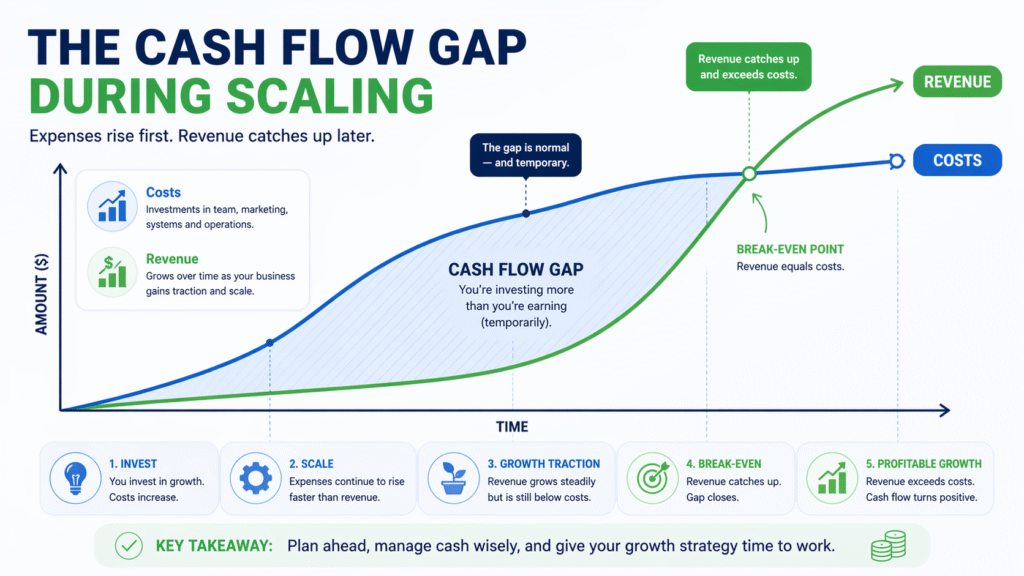
This cash flow gap has killed more scaling businesses than any other factor. Planning for it is not pessimism; it is basic financial intelligence.
Practical rule: Before scaling aggressively, ensure you have three to six months of operating expenses in reserve, or have committed access to capital that can cover the gap period.
Funding Options for Scaling
How you fund your scale-up depends heavily on your growth rate, your industry, and your long-term ownership goals. The main options are:
Bootstrapping: Using operational profits to fund growth. Slow, but preserves full ownership and forces capital discipline. Appropriate for businesses with strong cash flow and manageable growth ambitions.
Bank lending and SBA loans: Traditional debt financing for established businesses with solid financials. Typically requires two or more years of operating history and profitability. Non-dilutive, you keep full equity.
Revenue-based financing: A newer model where capital is provided in exchange for a percentage of future revenues until a multiple of the original investment is repaid. Appropriate for businesses with predictable, recurring revenue.
Angel investment and venture capital: Equity-for-capital. Fast, but dilutive. Appropriate for businesses with genuinely high-growth potential and founders willing to accept investors in the decision-making structure.
Strategic partnerships: Sometimes the best “funding” is a partnership with a business that provides resources, distribution, or infrastructure in exchange for a commercial arrangement rather than equity.
Unit Economics: The North Star of Scaling Finance
No financial metric matters more to a scaling business than unit economics. Specifically:
- Customer Acquisition Cost (CAC): How much does it cost, fully loaded, to acquire one new customer?
- Customer Lifetime Value (LTV): How much total revenue does one customer generate over their full relationship with you?
- LTV: CAC ratio: Industry standard for a healthy scaling business is 3:1 or higher
| Expert Benchmark LTV: CAC Ratio The 3:1 LTV: CAC benchmark is widely validated across SaaS, e-commerce, and services sectors. David Skok (Matrix Partners) and Christoph Janz (Point Nine Capital) both cite 3:1 as the minimum threshold for a scalable business model. For SaaS, Bessemer Venture Partners’ State of the Cloud report identifies 3:1–5:1 as the healthy range. Bessemer Venture Partners ↗ |
- Payback period: How many months does it take to recover the cost of acquiring a customer? Under 18 months is generally considered healthy
If you cannot articulate these numbers with confidence, your business is not ready to scale aggressively. Scaling with bad unit economics simply accelerates the losses.
People: Building the Team That Grows With You
Scaling is ultimately a people problem. The right team, in the right roles, with the right culture, is the difference between scaling that works and scaling that implodes.
Hire Ahead of Growth, Not After
A common mistake is waiting until a role is critically needed before hiring for it. By then, the founder or an existing team member is already carrying the role at unsustainable capacity, quality is suffering, and the new hire is being onboarded into a crisis rather than trained into a system.
Scaling businesses hire six to twelve months ahead of need. They bring on an operations manager before operations are a mess. They hire customer success before customer complaints become a pattern. This requires financial conviction; you are paying for capacity before you are fully using it, but it is consistently cheaper than the alternative.
The Four Hires That Unlock Scaling
Most founders scale through similar hiring sequences. The four hires that most consistently unlock a business’s ability to scale are:
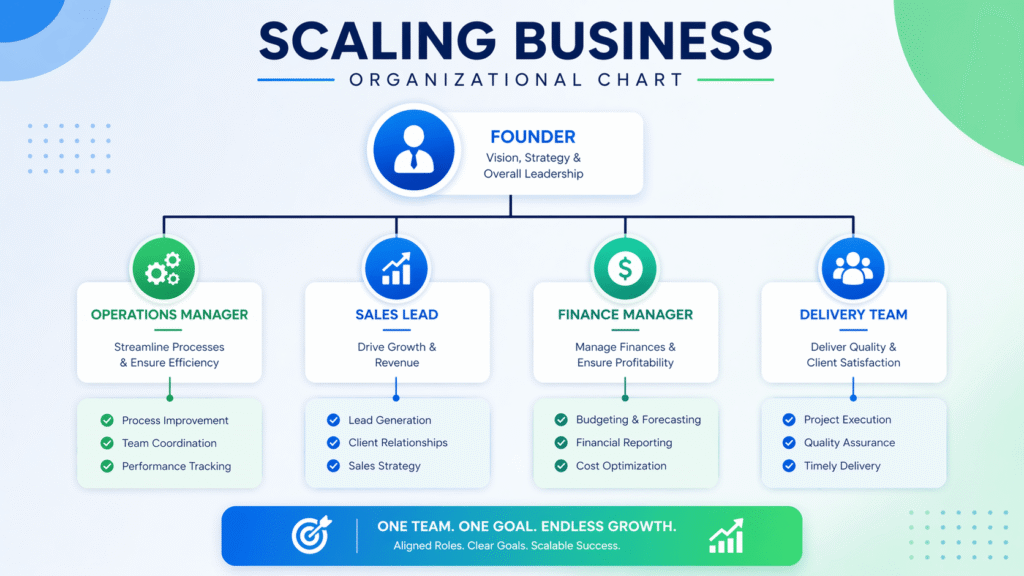
1. The operator (COO or Head of Operations). Someone who can run the day-to-day business so the founder can focus on strategy, sales, and vision. This is often the most transformational hire a founder makes.
2. The sales lead. A person who can own the sales process independently, build a pipeline, and close deals without the founder closing every sale personally.
3. The financial manager. Someone who owns cash flow, reporting, and the financial health of the business, not just bookkeeping, but genuine financial intelligence.
4. The delivery lead. Whether in production, service delivery, or technology, a person who owns the quality and consistency of what the business actually delivers to customers.
Culture Does Not Scale by Accident
The culture of a business of ten people will not automatically survive at fifty. Values, behaviours, and standards need to be explicit, documented, and actively managed as headcount grows. The businesses that scale culture successfully do three things differently: they hire for values as much as skills, they document cultural expectations explicitly rather than assuming them, and they hold leadership accountable for modelling the culture, not just describing it.
Common Business Scaling Mistakes to Avoid
Scaling failure is almost always preventable. The same mistakes appear with remarkable consistency across industries, business models, and geographies.
Scaling too early. The most common and most destructive mistake. Pouring growth capital and energy into a business that does not yet have a proven model, repeatable systems, or positive unit economics will accelerate the failure, not prevent it. The discipline to wait until genuine scaling readiness exists is one of the hardest things a founder will ever do.
Overexpansion. Growing in too many directions simultaneously, new markets, new products, new channels, new locations, before any single direction has been fully capitalised. Focus is the operating principle of successful scaling. Do one thing at a very large scale before attempting several things at a small scale.
Neglecting cash flow. Revenue growth is not the same as cash flow health. A business can show impressive revenue growth while running out of cash because collections are slow, expenses are front-loaded, or growth is consuming capital faster than it is generating it. Monitor cash flow weekly, not monthly.
Under-investing in systems. Founders who scale through personal effort and team hustle rather than through documented systems and technology create a fragile business that is entirely dependent on key individuals. When those individuals leave, and eventually they always do, the business loses operational continuity.
Copying another business’s scaling playbook without adapting it. What worked for a SaaS company will not necessarily work for a services business. What worked in the US market may not work in Nigeria or the Philippines. Context matters enormously in scaling. Use frameworks as starting points, not as prescriptions.
Ignoring customer feedback during growth. Fast-growing businesses sometimes stop listening to customers as carefully as they did when they were small and hungry. The product or service drifts from what customers actually need, and churn begins to climb just as acquisition is accelerating. Never let growth speed reduce the frequency or depth of customer conversations.
Key Metrics to Track When Scaling
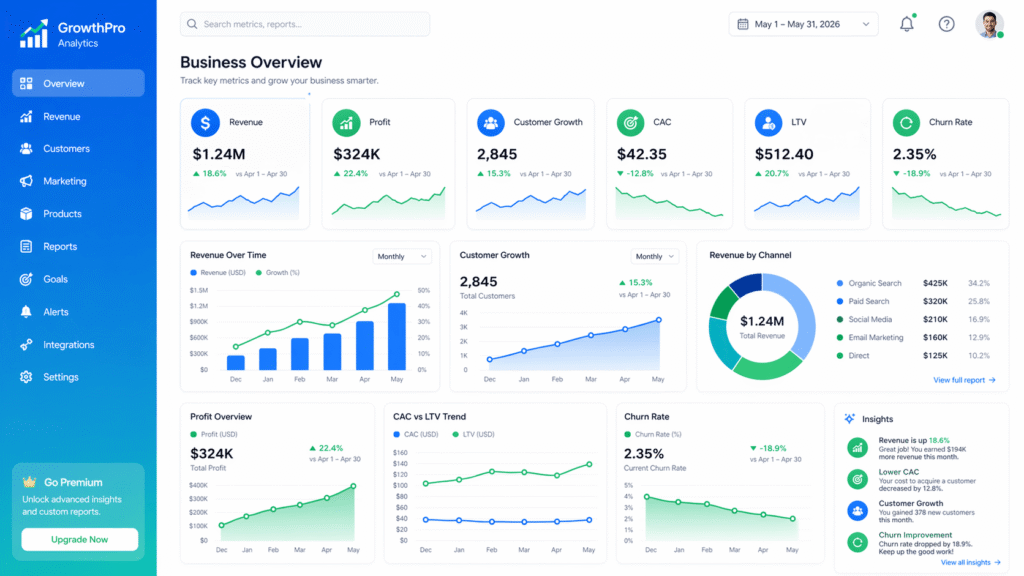
You cannot manage what you cannot measure. Scaling businesses track a disciplined set of metrics that provide early warning of problems and genuine evidence of progress.
Financial Metrics
- Monthly Recurring Revenue (MRR) or Annual Recurring Revenue (ARR): The predictable revenue backbone of a scaling business
- Revenue growth rate: Month-over-month and year-over-year
- Gross margin: Revenue minus cost of goods sold, expressed as a percentage. Scaling without improving gross margin is a warning sign
- Cash runway: At the current burn rate, how many months can the business operate?
- LTV: CAC ratio: See Finance section above
Operational Metrics
- Customer acquisition cost (CAC): Track by channel to understand which acquisition methods are most efficient
- Customer churn rate: The percentage of customers who cancel or do not renew in a given period
- Net Promoter Score (NPS): A proxy for customer satisfaction and referral likelihood
| What is Net Promoter Score (NPS)? Net Promoter Score was developed by Fred Reichheld at Bain & Company and introduced in the Harvard Business Review in 2003. It measures customer loyalty on a 0–10 scale: Promoters (9–10), Passives (7–8), Detractors (0–6). NPS = % Promoters − % Detractors. A score above 50 is considered excellent; above 70, world-class. Bain & Company: The NPS System ↗ |
- Employee productivity: Revenue per employee, or value delivered per employee, depending on your business model
- Time to onboard a new customer: How long from signing to active use? Reducing this directly impacts LTV
Growth Efficiency Metrics
- Burn multiple: How much cash is burned for every dollar of new ARR added? Below 1.5x is healthy for early-stage; below 1x is exceptional
- Rule of 40: For SaaS and subscription businesses, growth rate (%) plus profit margin (%) should exceed 40. A business growing at 30% with 15% margins scores 45 healthy
- Payback period: Already referenced above should be under 18 months for most scaling businesses
Business Scaling by Industry
Scaling looks meaningfully different depending on your business model. Here is a brief overview of the four most common contexts.
Service-Based Businesses
The classic challenge for service businesses is that the product is people, and people do not scale the way software does. The scaling levers here are productisation (packaging services into standardised offerings), technology (using software to do what junior staff previously did), and talent leverage (hiring well-trained, well-supported teams who multiply your capacity).
E-Commerce Businesses
E-commerce businesses scale through demand generation (paid ads, SEO, influencer partnerships), supply chain efficiency, and automation of fulfilment and customer service. The unit economics centre on blended CAC vs. average order value and repeat purchase rate. E-commerce-based small businesses grew by over 25% between 2020 and 2025, but profitability, not growth rate, is the real indicator of a scalable model.
SaaS and Software
SaaS is structurally the most scalable business model because the marginal cost of serving an additional customer approaches zero. The challenges are acquisition (CAC in competitive markets can be brutal), retention (churn is the silent killer of SaaS growth), and product development velocity. The Rule of 40 is the standard financial health benchmark.
| Expert Framework: The Rule of 40 The Rule of 40 was popularised by Brad Feld (Techstars) and has since been adopted as a standard SaaS health metric by McKinsey & Company, Bessemer Venture Partners, and most top-tier venture firms. McKinsey research shows that software companies exceeding the Rule of 40 generate 2.5x higher shareholder returns than those below it. McKinsey: The Rule of 40 for Software Companies ↗ |
Local and Physical Businesses
Scaling a local or physical business typically means either replication (opening more locations with a standardised operational model) or going digital (adding online channels to the existing physical business). Replication is capital-intensive and operationally demanding; the franchise model exists precisely to solve this problem.
Your Business Scaling Action Plan
Scaling is not an event; it is a programme. Here is a practical sequence to move from where you are to where you want to be.
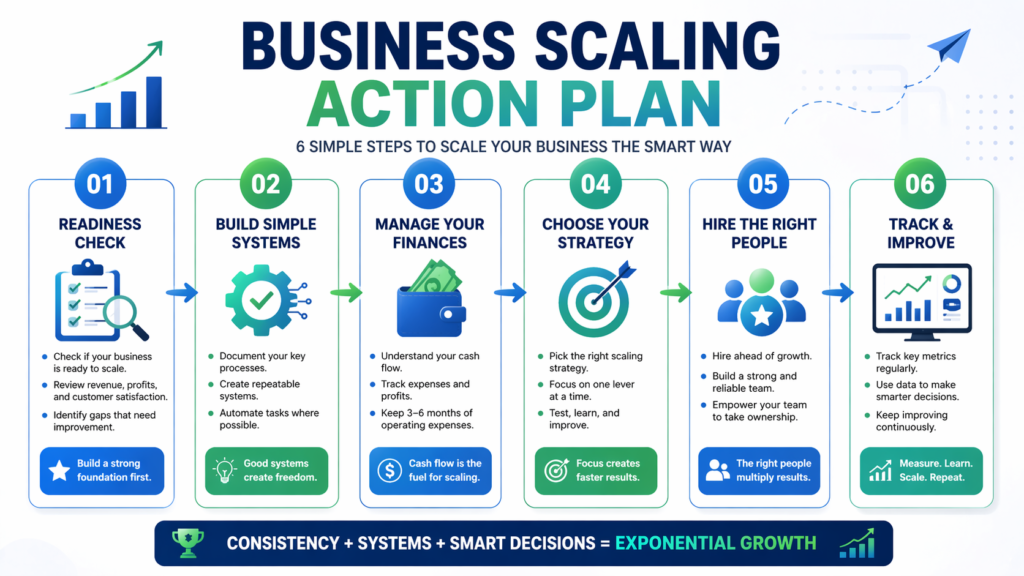
Step 1: Audit your scaling readiness. Use the seven readiness signals listed earlier in this guide. Score yourself honestly. Address any critical gaps before proceeding.
Step 2: Document your core processes. Spend thirty days building or improving your SOP library. Start with your highest-volume, most error-prone processes. This alone will free up significant founder time.
Step 3: Define your unit economics. Calculate CAC, LTV, and payback period by channel. If you cannot calculate them, your financial tracking needs to improve before scaling.
Step 4: Choose your primary scaling lever. Pick one from the strategy section above. Focus on it completely for at least six months before adding a second lever.
Step 5: Build the cash bridge. Identify how much capital you need to fund the gap between your scaling investment and the revenue it generates. Secure it before you need it.
Step 6: Make the four key hires. Identify which of the four scaling hires (operator, sales lead, finance manager, delivery lead) is most urgently needed. Hire it.
Step 7: Measure relentlessly. Set up a weekly metrics review that covers your key financial and operational numbers. Make decisions from data, not intuition.
Step 8: Iterate and protect culture. Review your scaling strategy quarterly. Explicitly manage culture as you grow. Stay in close contact with customers throughout.
Conclusion
Business scaling is one of the most challenging and most rewarding things a founder can attempt. It demands a shift in mindset from doing to designing, from executing to systemising, from a business that runs on your energy to one that runs on its own.
The businesses that scale successfully do not do so by working harder. They do so by building deliberately: stronger systems, smarter unit economics, the right team in the right roles, and a culture that survives growth rather than being crushed by it.
This guide is your starting point. Every section above links to a deeper resource in this content series, from building scalable operations to managing cash flow to hiring your first senior leadership team. Use them.
| About the Author: This guide was produced by an experienced business growth strategist with over a decade of hands-on experience advising founders, SMEs, and scale-ups across multiple industries. All statistics are sourced from primary research, including the SBA Office of Advocacy, Harvard Business Review, Tailor Brands Small Business Report 2025, and Semrush Keyword Intelligence Data. Last reviewed and updated: April 2026. Cite this resource: SBA Office of Advocacy · |
Frequently Asked Questions
What is business scaling?
What is the difference between scaling and growth?
What are the most common reasons businesses fail when scaling?
When should I start scaling my business?
What is a good LTV to CAC ratio?
Continue Reading: The Business Scaling Resource Library
This article is the pillar page of a complete content series on business scaling. Explore the cluster articles below to go deeper on every aspect covered here:
Foundations & Definitions
- What is business scaling? A complete breakdown
- Business scaling vs business growth: the definitive guide
- Signs your business is ready to scale
Strategy & Planning
- Business scaling strategies for small businesses
- How to create a business scaling plan
- Best business scaling frameworks (EOS, OKRs, Scaling Up)
Operations & Systems
- How to build scalable business systems and processes
- How to write SOPs for a scaling business
- Automation strategies for scaling businesses
Finance & Funding
- How to fund business scaling
- Cash flow management when scaling
- Bootstrapping vs raising capital to scale
Team & Leadership
- How to hire for a scaling business
- Building company culture while scaling
- When to hire a COO or operations manager
Challenges & Pitfalls
- Why businesses fail when scaling
- How to scale without losing quality
- Overcoming cash flow problems while scaling
Last reviewed and updated: April 2026. Statistics sourced from SBA Office of Advocacy, Tailor Brands Small Business Report 2025, Harvard Business Review, and Semrush Keyword Data.