Table of Contents
Introduction
Most businesses treat SEO like a separate task.
They write a blog post, hand it to an SEO specialist to “optimize,” and call it done. The content team, the paid ads team, the social media team — they all work in their own lanes.
That approach worked in 2015. It does not work in 2026.
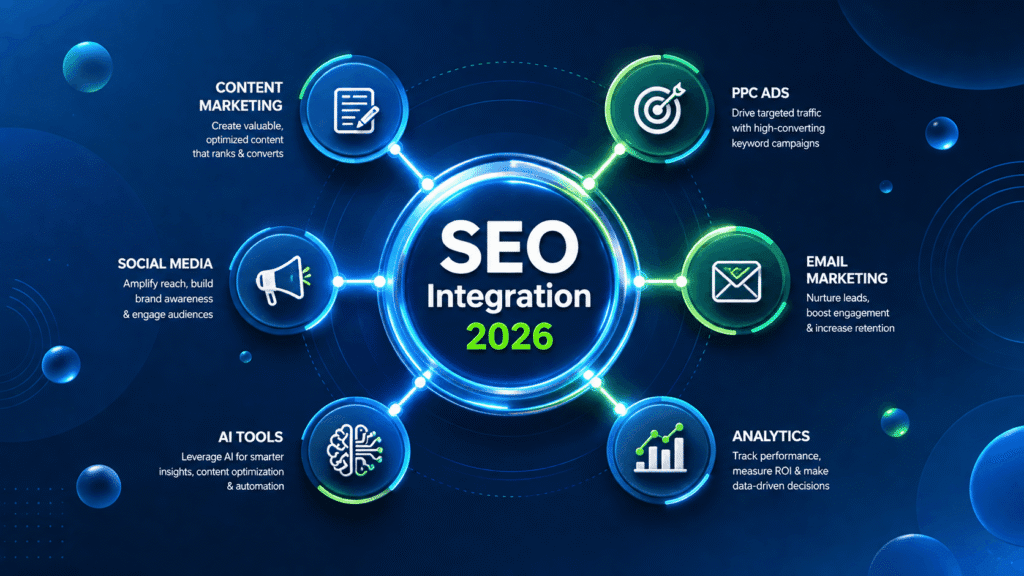
Today, the brands that dominate Google are the ones that have woven SEO into everything: their content, their ads, their website, their tools, and their marketing decisions. That is what SEO integration means. And it is one of the most important shifts you can make in your digital marketing strategy.
This guide explains exactly what SEO integration is, why it matters, and how to do it in plain language, with real examples. Whether you are a business owner, a marketer, or a complete beginner, you will finish this page with a clear picture of what to do next.
Here is what you will learn:
-
- What SEO integration actually means (and what it does not)
-
- The 8 specific ways to integrate SEO into your business
-
- A step-by-step framework for building an integrated SEO strategy
-
- The most common mistakes companies make and how to avoid them
-
- The best tools to make integration easier
-
- Answers to the most-asked questions about SEO integration
Let’s start from the beginning.
1. What Is SEO Integration?
SEO integration is the process of connecting your SEO strategy with every other part of your marketing and business operations so they all work together toward the same goal.
If you’re new to the concept, start with our guide explaining what SEO integration actually means.
Think of it this way.
Imagine your marketing strategy as a car. SEO alone is just one wheel. It might spin, but the car will not go very far. SEO integration means connecting all four wheels: content, paid ads, social media, analytics, your website, and making sure they all turn in the same direction.
SEO Integration vs. Traditional SEO
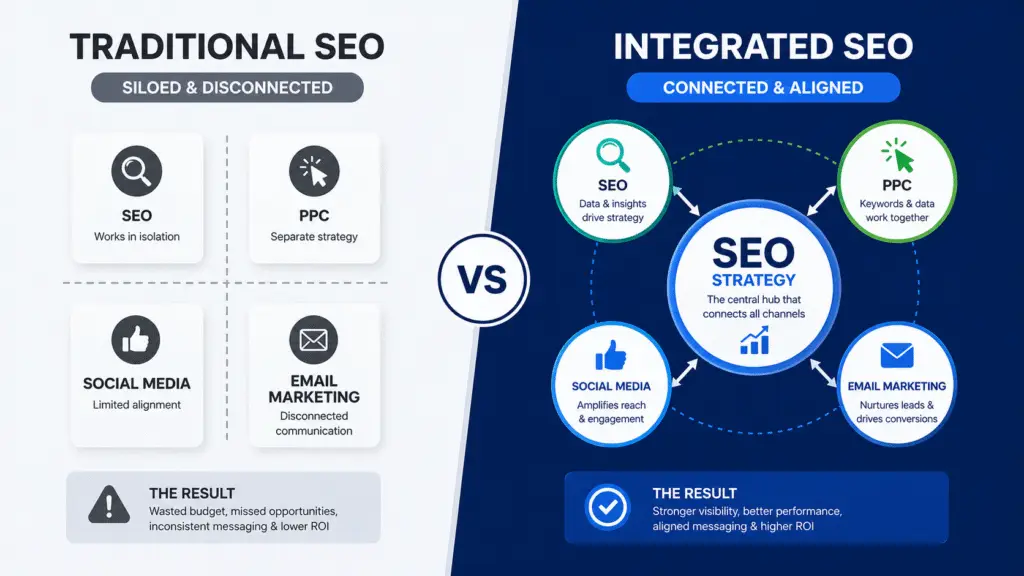
Here is the difference between traditional SEO and integrated SEO:
| Traditional SEO | Integrated SEO |
| Separate team or task | Built into every marketing decision |
| Focused only on rankings | Focused on traffic, leads, and revenue |
| Keyword research is done once | Keyword insights guide all content. |
| Blog posts optimized in isolation | All channels share the same keyword strategy. |
| Analytics reviewed monthly | Data is used in real time across teams. |
| Reactive (fix problems after they happen) | Proactive (SEO is considered from day one) |
What SEO Integration Is NOT
It is important to clear up a common misconception: SEO integration is not about doing more SEO tasks. It is about doing your existing marketing tasks with SEO in mind from the start.
It does not mean:
-
- Adding keywords to every single piece of content
-
- Turning every social media post into a keyword-stuffed article
-
- Ignoring the user experience in favour of search rankings
It means making smarter decisions, using the data and insights that SEO gives you to strengthen every part of your marketing.
2. Why SEO Integration Matters in 2026
Here is the reality: the way people search has changed dramatically, and it keeps changing.
In 2026, several major shifts make SEO integration not just useful, but essential.
Google rewards topical authority, not isolated pages
Google’s algorithm has become incredibly sophisticated. It no longer looks at individual blog posts in isolation. It looks at your entire website and asks: Does this site genuinely understand this topic?
Websites that cover a topic in depth, with interconnected pages that all reinforce each other, rank consistently higher than websites with scattered, unrelated content. This is exactly what an integrated SEO strategy creates.
AI search is changing how people find information.
Tools like Google’s AI Overviews, ChatGPT, and Perplexity now answer questions directly, pulling from websites they consider the most authoritative. If your content is not integrated, consistent, and genuinely helpful, it will not be cited by these tools. If it is, you gain visibility in AI-generated answers, a new and growing source of traffic.
Zero-click searches are rising.
Research shows that more than half of all Google searches now end without a click. People get their answer directly from the search results page. The only way to win in this environment is to provide such clear, structured, and trusted content that Google features your page in a snippet, a knowledge panel, or an AI summary. Integrated SEO makes this possible.
The competition is getting smarter.
Your competitors are no longer writing basic keyword-stuffed blog posts. The top-ranking pages in almost every industry are comprehensive, well-structured, and supported by dozens of related articles. If your SEO strategy is still isolated, you are bringing a single piece of paper to a chess match.
The numbers support it.
-
- Organic search generates 44.6% of all B2B revenue — the single largest channel (First Page Sage, 2025)
-
- SEO leads have a 14.6% close rate, compared to 1.7% for outbound methods
-
- Websites with a clear topic cluster strategy rank for 3x more keywords on average than websites with isolated blog posts
3. The 8 Types of SEO Integration
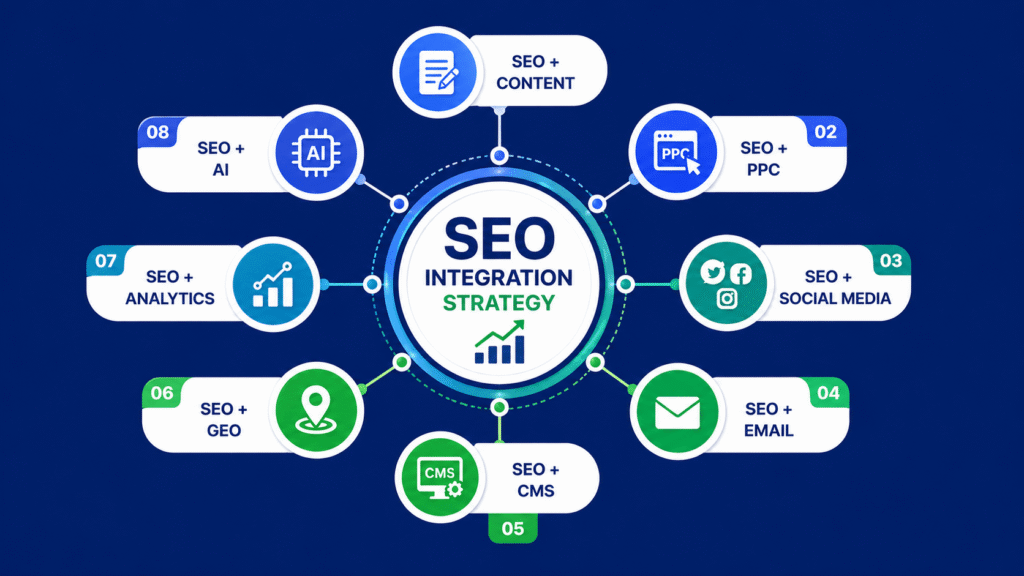
SEO integration does not happen in one place. It happens across eight key areas of your marketing and tech stack. Here is a brief overview of each, with links to our in-depth guides for each type.
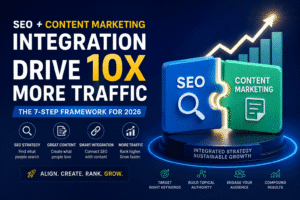
3.1 SEO + Content Marketing Integration
This is the foundation of everything. Content marketing and SEO are not two separate strategies — they are two sides of the same coin.
When you integrate them, every piece of content you create is built around real search demand. You use keyword research to decide what to write, search intent to decide how to write it, and SEO data to measure whether it is working.
The result: content that people actually search for, that ranks in Google, and that builds your authority over time.
If you want a deeper breakdown of how to apply this in practice, see our guide on how to integrate SEO into your content, where we explain keyword research, structure, and optimization step by step.
3.2 SEO + PPC Integration
Most businesses treat their SEO team and their paid ads (PPC) team as completely separate. This is a costly mistake.
When SEO and PPC work together, you get:
-
- Better keyword data — use PPC campaigns to test which keywords actually convert, then invest in those organically
-
- Lower costs — use organic rankings to reduce your paid ad spend on terms you already rank for
-
- Bigger SERP presence — appear in both paid and organic results for the same keyword, doubling your visibility
-
- Smarter bidding — use SEO insights to avoid bidding on terms that are too broad or have the wrong intent
Example: If your PPC campaign shows that the keyword “SEO tools for small business” has a 12% conversion rate, you know it is worth targeting organically, too.
3.3 SEO + Social Media Integration
Social media does not directly affect Google rankings. But it has a powerful indirect impact that most marketers overlook.
When you share well-optimized content on social media, you:
-
- Drive traffic to pages that Google then sees as popular
-
- Earn shares that put your content in front of people who may link to it
-
- Build brand searches for people who discover you on social and then Google your name
-
- Gather audience data that informs your keyword and content strategy
The smartest brands use social media as a distribution engine for their SEO content, getting it in front of people who would never have found it through search alone.
3.4 SEO + Email Marketing Integration
Your email list is one of your most powerful assets, and most brands do not use it to support their SEO at all.
Here is how SEO and email work together:
-
- Traffic boost on day one: When you publish a new piece of SEO content, send it to your list. This immediate traffic surge signals to Google that the content is worth showing.
-
- Keyword insight from your audience: The questions your subscribers ask in replies and surveys are often exact search queries you should be targeting.
-
- Re-engagement: Bring people back to older, high-value pages that are starting to rank, refreshing their traffic and keeping them competitive.
3.5 SEO + CMS Integration
Your CMS (Content Management System), whether it is WordPress, HubSpot, Webflow, or something else, is the engine room of your SEO. If it is not set up correctly, all the great content in the world will not save you.
Key areas of CMS integration include:
-
- URL structure: Clean, keyword-rich URLs that match your content hierarchy
-
- Internal linking automation: Tools and plugins that suggest and manage links between related pages
-
- Site speed optimization: Ensuring your CMS delivers pages fast (a Core Web Vitals requirement)
-
- Schema markup: Adding structured data automatically at the template level
-
- SEO plugins: Yoast, Rank Math, or SEOPress for WordPress; built-in tools for HubSpot and others
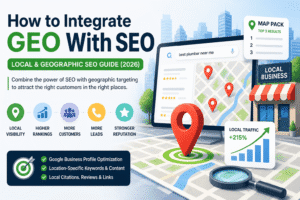
3.6 SEO + GEO Integration (Local & Geographic SEO)
If your business serves specific locations, whether a local area or multiple regions, integrating SEO with geographic targeting is critical.
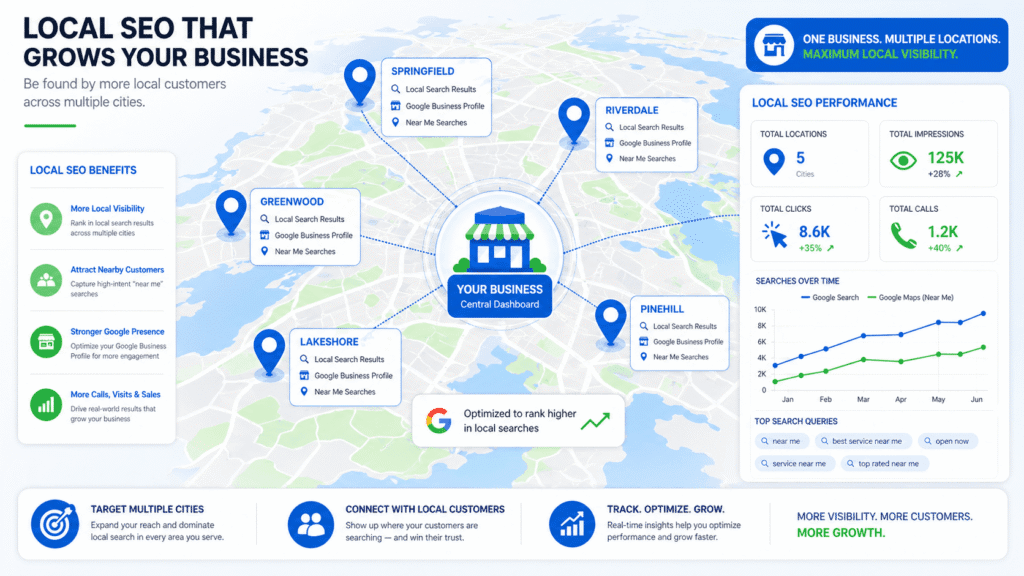
GEO integration means:
-
- Optimizing your Google Business Profile
-
- Creating location-specific landing pages built around local keywords
-
- Building local citations (mentions of your business name, address, and phone number across the web)
-
- Understanding how “near me” searches work and how to win them
-
- Combining traditional local SEO with broader regional keyword strategies
For a practical guide, see how to integrate local and geographic SEO.
3.7 SEO + Analytics Integration (GA4 + Google Search Console)
Data is the fuel that makes integrated SEO work. Without the right analytics setup, you are flying blind.
The two essential tools are:
-
- Google Analytics 4 (GA4): Tracks what happens after someone arrives on your site, pages visited, time on site, conversions, and revenue
-
- Google Search Console (GSC): Shows you exactly what keywords people use to find you, how often your pages appear, and how many people click
When these tools are properly integrated with your SEO strategy, you can see exactly which keywords are driving real business results, not just traffic.
3.8 AI + SEO Integration
This is the newest and fastest-growing area of SEO integration.
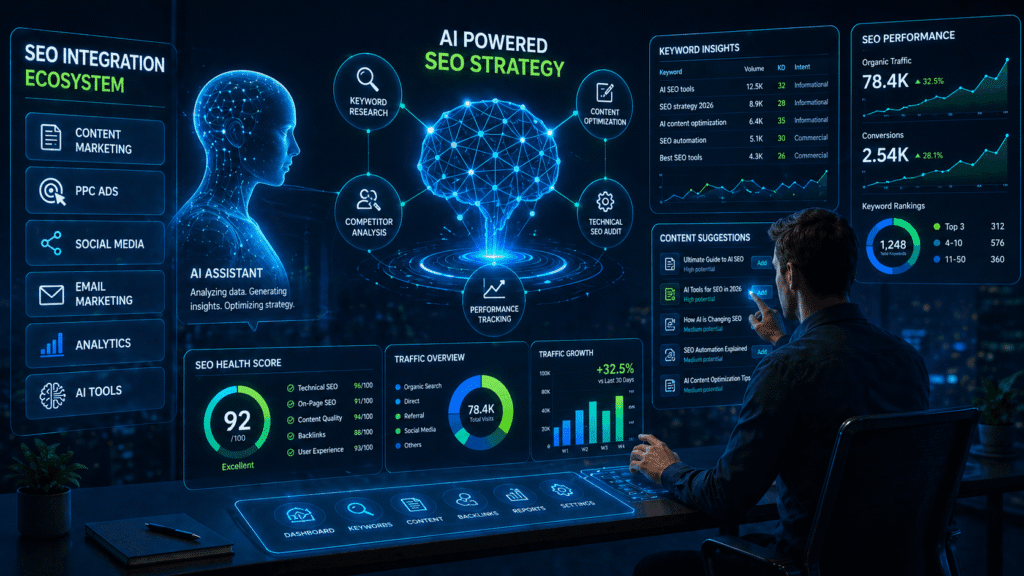
In 2026, AI tools are being used across every stage of the SEO process: keyword research, content creation, technical audits, content briefs, and even competitor analysis. The brands winning at SEO right now are using AI to work faster and smarter, not to replace human judgment, but to sharpen it.
Key AI + SEO integrations include:
-
- Using AI to generate content briefs from keyword clusters
-
- Using AI to identify content gaps your competitors have missed
-
- Using AI-powered tools like Semrush Copilot, Surfer AI, or ChatGPT to assist with first drafts
-
- Optimizing content for AI-generated search summaries (Google AI Overviews)
4. How to Build an Integrated SEO Strategy (Step by Step)
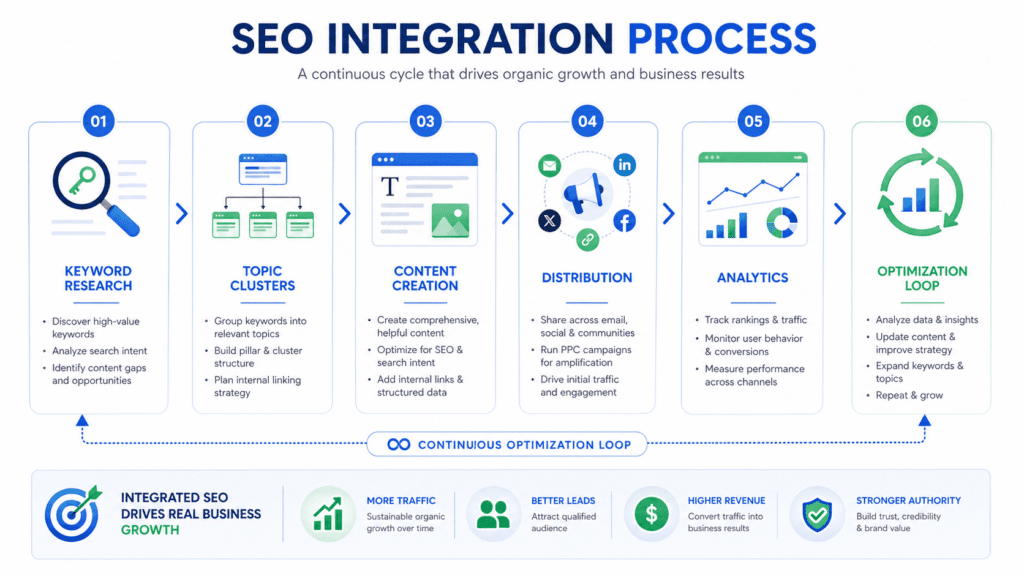
Now that you know what SEO integration looks like across different channels, here is exactly how to build your own integrated SEO strategy, even if you are starting from scratch.
Step 1: Start with a keyword and topic audit
Before you integrate SEO into anything, you need to know what keywords and topics matter to your audience.
How to do it:
-
- Use a tool like Semrush, Ahrefs, or Google Keyword Planner
-
- Enter your core topic (e.g., “seo integration”)
-
- Look at the keyword variations. What questions do people ask? What problems are they trying to solve?
-
- Group related keywords into topic clusters, groups of related searches that can be addressed by a set of connected articles
This keyword map becomes the foundation of your entire integrated strategy. Every channel, content, PPC, social, and email uses the same keyword intelligence.
Pro tip: Do not just look at search volume. Look at keyword intent. A keyword with 200 searches per month and commercial intent is often more valuable than a 2,000-search keyword with unclear intent.
Step 2: Build your pillar and cluster content architecture
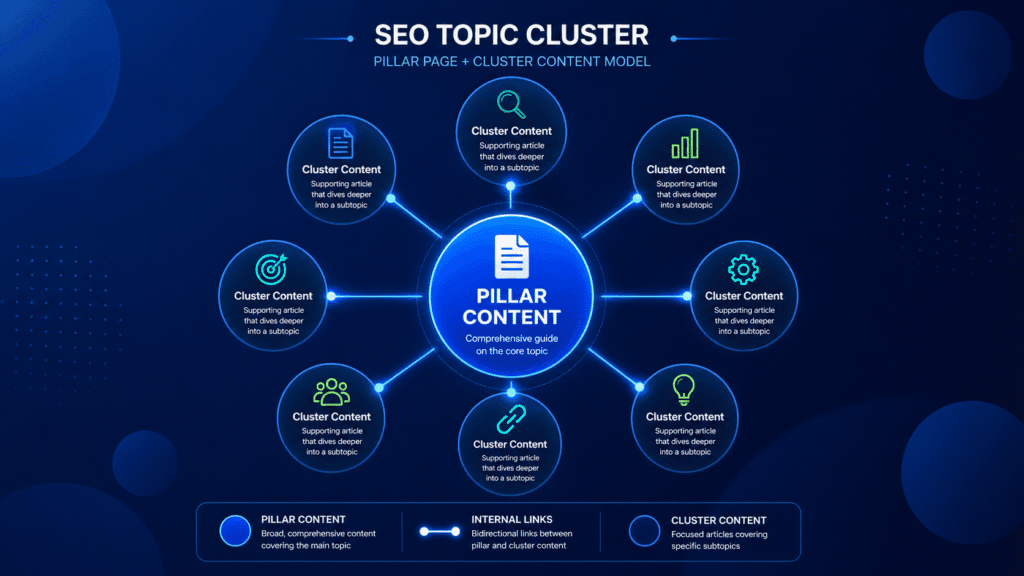
Once you have your keyword map, organize your content into a pillar and cluster model.
-
- Pillar page: One comprehensive guide that covers your core topic broadly (this page is an example)
-
- Cluster articles: A set of detailed guides, each covering one specific subtopic in depth
Every cluster article links back to the pillar. The pillar links out to every cluster. This internal linking structure tells Google that your website is the most authoritative resource on this topic.
A well-built topic cluster can rank for dozens, sometimes hundreds, of related keywords, not just the one you originally targeted.
Step 3: Align your PPC keyword strategy with your SEO strategy
Pull your top-performing PPC keywords and compare them to your SEO targets.
Ask three questions:
-
- Which paid keywords are converting well that you have not yet targeted organically?
-
- Which organic rankings have you already achieved that you can reduce your PPC spend on?
-
- Which keywords are too competitive for organic search right now but worth testing in paid ads to validate demand?
This cross-channel keyword alignment ensures you are not wasting money on paid ads for terms you could rank for organically, and not missing organic opportunities your paid campaigns have already validated.
Step 4: Set up your analytics integration
You cannot improve what you cannot measure. Before publishing a single piece of integrated content, make sure your data infrastructure is in place.
Minimum setup:
-
- Google Analytics 4 properly configured on your website
-
- Google Search Console verified and linked to GA4
-
- Conversion tracking set up (form submissions, phone calls, purchases)
-
- A regular reporting process — weekly for fast-moving campaigns, monthly for steady-state strategies
This setup ensures that when your SEO integration starts working, you can see exactly where the results are coming from.
Step 5: Create your content and optimize it properly
Now you write. But “optimized content” does not mean keyword-stuffed content. It means content that is:
Comprehensive: Covers the topic fully, so the reader never needs to go elsewhere.
Structured clearly: Uses H2s and H3s to organize information logically. Each heading should answer a clear question.
Written for humans first: Simple language, short paragraphs, genuine examples. If a 15-year-old cannot understand it, rewrite it.
Technically correct: Proper title tag, meta description, URL, image alt text, and internal links. These are not optional — they are the basic entry fee for competitive rankings.
Supported by credible sources: Link out to authoritative data, studies, and tools. This signals E-E-A-T (Experience, Expertise, Authoritativeness, Trustworthiness) to Google.
Step 6: Distribute content across all integrated channels
Once your content is live, use every channel to amplify it.
-
- Email: Send a summary to your list with a link to the full article
-
- Social media: Share key insights as individual posts; one article can fuel 5–10 social posts
-
- PPC: Run a short paid campaign to the pillar page to give it an early traffic boost
-
- Internal links: Update older, related content on your site to link to the new article
This multi-channel distribution gives your new content an immediate traffic signal — telling Google it is worth paying attention to.
Step 7: Monitor, update, and improve
SEO integration is not a “publish and forget” strategy. It requires ongoing attention.
Every month:
-
- Review your Search Console data — what queries are you appearing for? What are you missing?
-
- Check your rankings for primary and secondary keywords
-
- Look at which pages are getting traffic but not converting — and improve them
Every quarter:
-
- Update your pillar and high-traffic cluster articles with new data and insights
-
- Identify new keyword opportunities in your topic cluster
-
- Review your backlink profile — are you earning links? If not, create content worth linking to
Every year:
-
- Conduct a full content audit — what is working, what is stagnant, what should be merged or removed?
-
- Re-evaluate your topic cluster structure — are there new subtopics worth covering?
5. SEO Integration Best Practices
These are the principles that separate great integrated SEO from average SEO.
Use one keyword strategy across all teams.
Your content team, your paid ads team, and your social media team should all be working from the same keyword research. When different teams use different keyword data, you get inconsistent messaging and missed opportunities.
Create a shared keyword database, even a simple Google Sheet works, and make sure everyone uses it.
Let search intent guide your content format.
Not every keyword should become a blog post. The format of your content should match what searchers are expecting.
-
- “What is SEO integration?” → Long-form guide or definition article
-
- “Best SEO integration tools” → Listicle or comparison article
-
- “How to integrate SEO into WordPress” → Step-by-step tutorial
-
- “SEO integration services” → Service landing page
Get the format wrong, and Google will not rank you, even if your content is excellent.
Make internal linking a habit, not an afterthought
Every time you publish new content, spend 15 minutes finding 3–5 older pages on your site that could link to the new page and add those links. Then find 3–5 relevant links from the new page to existing content.
This habit, done consistently, builds a powerful internal link network that distributes authority across your entire site.
Write for featured snippets on every question keyword
For any question-based keyword you are targeting, structure your answer in a clear, concise paragraph of 40–60 words directly below the H2 or H3 that states the question. This is the format Google most often pulls into featured snippets.
Keep your technical SEO clean.
The best content in the world will not rank if your website has serious technical problems. The minimum technical SEO checklist every integrated strategy needs:
-
- Pages load in under 3 seconds on mobile
-
- Your site is mobile-friendly (test with Google’s Mobile-Friendly Test)
-
- You have an XML sitemap submitted to Google Search Console
-
- No broken links or redirect chains
-
- All important pages are indexable (not accidentally blocked by robots.txt)
-
- Canonical tags are correctly implemented on duplicate or near-duplicate pages
6. Common SEO Integration Mistakes to Avoid
Even well-intentioned teams make these mistakes. Here is what to watch out for.
Mistake 1: Treating SEO as an afterthought
The most common and costly mistake: creating content first, then asking the SEO team to “fix it.”
By the time content is written, the keyword angle, the title, the structure, and the internal links have already been decided. Adding SEO after the fact is like trying to add a foundation to a house that is already built.
Fix: Involve SEO at the planning stage — before a word is written.
Mistake 2: Targeting too many keywords on one page
Each page should focus on one primary keyword and a handful of closely related secondary keywords. When you try to target too many keywords on a single page, you dilute its relevance and confuse Google about what the page is actually about.
Fix: Use one primary keyword per page. Use keyword variations and related terms naturally throughout the content.
Mistake 3: Ignoring search intent
Ranking for the wrong type of content is just as bad as not ranking at all. If someone searches for “how to integrate SEO” and you show them a sales page for your SEO service, they will leave immediately, and Google will notice.
Fix: Before writing any piece of content, search for your target keyword and look at what is already ranking. The top results show you exactly what format and angle Google expects.
Mistake 4: Building links before building content
Some businesses invest heavily in link-building before they have great content to link to. Links pointing to thin, average content do very little.
Fix: Build your content architecture first. Then earn links to content that genuinely deserves them.
Mistake 5: Siloing your keyword data
When the content team uses one keyword tool, the PPC team uses another, and the social team uses none, everyone operates on different assumptions. This creates inconsistent messaging and missed cross-channel opportunities.
Fix: Centralize your keyword research into a shared document or workspace that all teams can access and contribute to.
Mistake 6: Forgetting to update existing content
Many brands focus entirely on creating new content while their existing content slowly loses rankings. Pages that once ranked on page 1 can drift to page 3 in 6–12 months if they are never refreshed.
Fix: Put a content review process in your calendar. Check your top 20 pages every quarter and update any that are losing traffic or ranking position.
Mistake 7: Measuring only rankings, not revenue
Rankings are a vanity metric if they do not connect to business outcomes. A page ranking #1 for a keyword that drives no conversions is not a success.
Fix: Set up conversion tracking from day one. Measure organic traffic, leads, and revenue, not just keyword positions.
7. Best Tools for SEO Integration
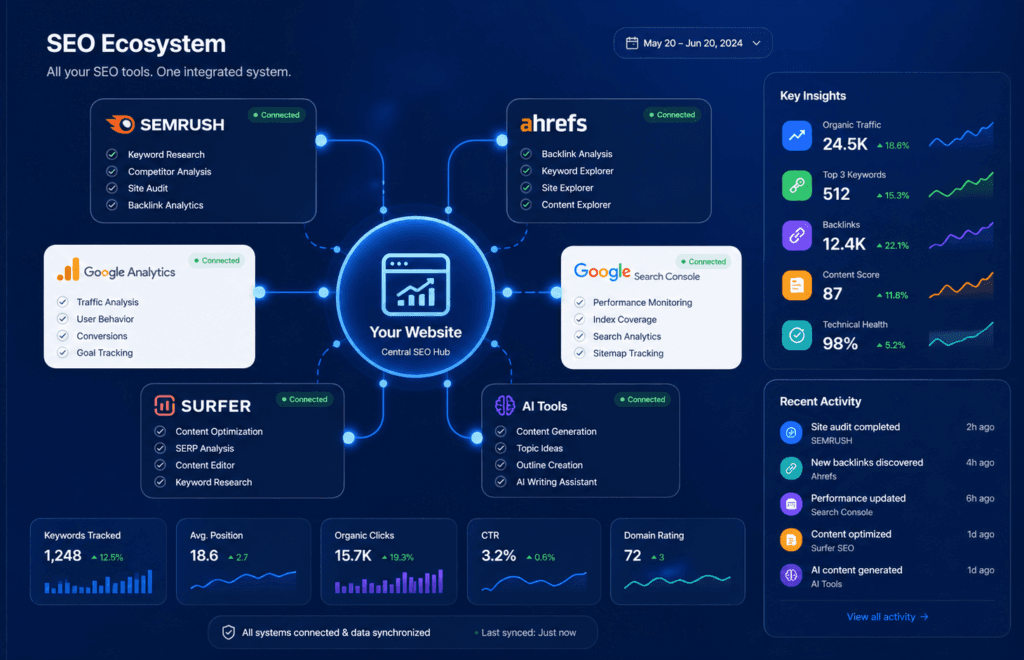
Here are the most important tools, organized by function.
Keyword Research & Strategy
-
- Semrush — The most comprehensive all-in-one tool. Keyword research, competitor analysis, content gap analysis, site audit, and rank tracking in one platform.
-
- Ahrefs — Exceptionally strong for backlink analysis and keyword difficulty scoring.
-
- Google Keyword Planner — Free and directly from Google. Best for validating search volume estimates.
Content Optimization
-
- Surfer SEO — Analyzes the top-ranking pages for your keyword and tells you exactly how to structure and optimize your content to compete.
-
- Clearscope — Similar to Surfer, with a strong focus on topical depth and related keyword coverage.
-
- Yoast SEO / Rank Math — Essential WordPress plugins for on-page SEO. Handle meta titles, meta descriptions, schema, and XML sitemaps.
Analytics & Tracking
-
- Google Analytics 4 — The standard for website traffic and conversion tracking. Free.
-
- Google Search Console — The definitive source of truth for your organic search performance. Free.
-
- Looker Studio (Google Data Studio) — Build custom dashboards that combine GA4 and GSC data for a complete view of your SEO performance.
Technical SEO
-
- Screaming Frog — Crawls your website and identifies technical SEO issues: broken links, missing meta tags, duplicate content, and more.
-
- PageSpeed Insights — Google’s free tool for checking your Core Web Vitals scores.
-
- Schema Markup Generator (by Merkle) — Generate structured data code without needing to write JSON-LD from scratch.
AI-Assisted SEO
-
- Semrush Copilot — AI-powered recommendations built into the Semrush platform.
-
- ChatGPT / Claude — Excellent for generating content briefs, FAQ sections, outlines, and meta descriptions at scale.
-
- Perplexity AI — Useful for researching topics quickly with cited sources.
8. Real Examples: What Integrated SEO Looks Like in Practice
Understanding SEO integration in theory is useful. Seeing it in practice is better.
Here are three simplified examples of what integrated SEO looks like when it is working.
Example 1: The B2B SaaS Company
The situation: A project management software company was publishing 4 blog posts per month but seeing flat organic traffic. Each post targeted a different keyword, and none of them linked to each other.
What they changed:
-
- Conducted a full keyword audit and identified their core topic: “project management software for remote teams.”
-
- Built a pillar page on this topic and organized their existing 40+ blog posts into six topic clusters
-
- Added internal links connecting all cluster articles to the pillar page and to each other
-
- Used their PPC keyword data to identify two new cluster topics that were converting in paid ads but had no organic content
Result: Organic traffic increased by 67% in 5 months. Their pillar page ranked #4 for the primary keyword, and the cluster articles collectively ranked for 380+ related keywords.
Example 2: The E-Commerce Brand
The situation: An online home goods retailer was relying entirely on paid ads for traffic. Their organic traffic was minimal, less than 8% of total visits.
What they changed:
-
- Integrated their PPC keyword data into a content strategy — writing buying guides around the product keywords that converted best in paid search
-
- Optimized every product page with proper H1 tags, descriptive meta titles, unique product descriptions, and customer review schema
-
- Built a blog section organized into topic clusters (e.g., “home organisation,” “small space living”) that linked back to product category pages
Result: Organic traffic grew from 8% to 34% of total traffic over 9 months. The blog clusters drove visitors directly into product funnels — with a 6.2% conversion rate on organic traffic (higher than their paid traffic rate of 4.8%).
Example 3: The Local Service Business
The situation: A plumbing company in three cities was not appearing in local search results. Their website had one home page, no blog, and no location-specific pages.
What they changed:
-
- Created a location-specific landing page for each city they served, optimized for “[city] + plumbing service” keywords
-
- Claimed and optimized their Google Business Profile for each location
-
- Published a blog with content answering common plumbing questions (e.g., “how to fix a leaking tap,” “signs your boiler needs replacing”) — targeting informational keywords that their ideal customers were searching for
-
- Built citations (NAP — Name, Address, Phone) consistently across 50+ local directories
Result: They appeared in the Google Map Pack for their primary city within 8 weeks. Total inbound enquiries from organic search grew by 140% over 6 months.
9. Frequently Asked Questions
These are the most common questions people ask about SEO integration, drawn directly from real search queries.
What does SEO integration mean?
How do you integrate SEO into your content?
What is the difference between SEO and integrated SEO?
How long does it take for SEO integration to show results?
What tools do I need for SEO integration?
Google Search Console (free) — to track your organic search performance
Google Analytics 4 (free) — to track traffic, behavior, and conversions
One SEO research tool — Semrush, Ahrefs, or Moz for keyword research and competitor analysis
As your strategy grows, you can add content optimization tools (Surfer SEO, Clearscope), technical audit tools (Screaming Frog), and AI-assisted content tools.
Can small businesses do SEO integration?
How do I integrate SEO with content marketing?
What is GEO integration in SEO?
How do SEO and PPC work together?
10. Next Steps: Your Integrated SEO Roadmap
You now have a complete picture of what SEO integration is, why it matters, and how to build it. Here is a simple action plan to start implementing it today.
This week:
-
- Run a keyword audit on your core topic using Semrush or Google Keyword Planner
-
- Identify your 3–5 most important subtopics (your first cluster)
-
- Check your existing content to see if any of it already covers these subtopics. If so, update and link them together
This month:
-
- Publish your first cluster article targeting the easiest-to-rank keyword in your cluster (look for keywords with KD under 20)
-
- Set up Google Search Console if you have not already
-
- Add internal links between your existing content
This quarter:
-
- Build out your full cluster of 8–12 articles
-
- Set up GA4 conversion tracking
-
- Begin a simple link-building campaign for your pillar page
SEO integration is not something you achieve overnight. It is something you build, piece by piece, article by article, until your entire digital presence is working together as one coordinated system.
When that happens, the results compound. Each new piece of content strengthens the ones before it. Each new ranking opens the door to more keywords. Each new backlink lifts your entire site.
That is the power of integrated SEO.
Sources & Further Reading
-
- Semrush Keyword Overview — “SEO Integration” keyword data (April 2026)
-
- First Page Sage — B2B SEO ROI Research (September 2025)
-
- Whitehat SEO — Keyword Research B2B Guide 2026
-
- Backlinko — Search Intent in SEO (February 2026)
-
- Ahrefs Blog — Topic Clusters and Pillar Pages